Having visited other world cities - London, Paris, Berlin, Milan, Rome, Moscow and now more recently Istanbul and Toronto - we were very keen to see Beijing. We almost didn't make it due to problems buying tickets and concerns about the children, but in the end we were able to make two short trips. We didn't regret it.


Sophia and I travelled to Beijing by bullet train. The Japanese-style trains - with airport-style train stations to match - were absolutely fantastic. We were travelling at 300 kmph for two hours in comfort for 20 pounds return. Very convenient and a classic example of the New China.

 The actual Forbidden City is at one end of Tiananmen Square, separated by a busy main road. Its design is a series of several pagoda-style gate houses finally leading you to the throne of the Emperor. The first gate house now features a huge photo of Chairman Mao, founder of the People's Republic. Visitors pass through this first gate through a tunnel and into the first huge courtyard. On our first visit, due to earlier winter closing times, this is as far as we got. However the following day we managed to get into the main attraction and walked through several courtyards and gate-houses, taking in the ornate painted woodwork. The official map shows the vastness of the complex, littered with neatly places pagodas, each a sight in their own right. Only the cold distracted from the awe-inspiring reality of being metres away from the seat of the most powerful man on earth for much of recorded history. Time was not on our side and we had trains to catch, so we had to make our way through the complex at increasing pace. You emerge the other end of the Forbidden City somewhat in the middle of nowhere, although having been told the number of the trolleybus we made it back to where we needed to be.

The evening of the first day of our visit, Lawrence and I decided to go and explore the city by night. It was a chance for a little adventure and also for some time to chat. Coming out of the hotel around 10-ish we realised it might be difficult to get transport and the taxi drivers wanted ridiculous sums of money to take us where we wanted to go. In the end we gambled on an electric rickshaw... Quite an experience. He took us along all the backstreets, the traditional hutongs, in the pitch dark. At one point we had a large car very close to our tail. At another he randomly stopped to change batteries. What had looked like fibreglass sides were actually cloth, keeping in the heat, but rather flimsy in the event of a collision (no, we were fine). We finally arrived at our destination, Qianmen street. By the time we got there the pedestrian precinct with a tram line running down the middle and major global brands like Haagen Daas and others, was deserted and closed. However turning off the main street we entered another world - a labyrinth of narrow alleyways packed with establishments selling food. We walked and walked, looking for somewhere still open and finally found a cafe-like place with a statue of Mao and friendly-looking staff. They can't have seen many foreigners because they insisted on taking our picture and asked Lawrence lots of questions about where we were from. The bill for the meal was also a fraction of what we had paid elsewhere and we had plenty eat and lots left over. We made our way back not knowing whether we found find transport, but there were plenty of taxis on the main road and it only cost us half of the rickshaw fare to get back (that's what comes of using the official meter instead of making up the price).

 The next day we got up early for our trip to the Great Wall. I can't imagine there is anyone who has not heard of this great feat of engineering. It isn't disappointing and after an hour or so of driving due north from the city one starts to head uphill until the Wall is visible on the ridge of the mountains. The whole thing took something like 2000 years to build and its total length is over 8800 kms (only half is currently restored). That is something like the entire length of Russia from one end to another... of wall! The Wall, or the bit we visited, is accessible by cable car. The actual Wall, built of yellowy-grey stone, is rather like an extended rampart around a castle - only stretched out in one direction. Every 50 metres or so the wall is interrupted by a sort of turret, which is where soldiers would have been stationed. The edifice snakes off into the distance in either direction and one has a sense both of its magnitude and of the historical significance of this front-line of Chinese civilisation. When it came down to it the Mongols still got through and occupied the throne for a whole dynasty - although they say that it was the conquered who ultimately changed the conqueror and not vice versa. It was one of those sights which it actually doesn't take that long to visit. I guess we could have walked along for some distance, but Sophia's feet were frozen and it was slippy, so having seen it and taken the photos we made our way back.

We said goodbye to Conrad and Jenny in Beijing and headed off for our train back. I will save the account of our second Beijing visit for another post.
Beijing is not the ancient capital of China and, if memory serves, it has only been the capital city since the times of the Mongol ascendency in the 13th century, which incidentally coincided with the visit of Marco Polo. However that takes nothing from its stature and magnificence in today's China and today's world.
The population of the city, whose name means 'Northern Stone', is around the 20 million mark. The smog problems publicised at the time of the 2008 Olympics and in the last few weeks were not a problem when we were there, however one is aware of being in a huge metropolis. Old and new peacefully co-exist, with vast housing complexes and commercial tower blocks intermingled with ancient pagoda's and the traditional hutongs (low-rise housing connected by narrow alley-ways). Beijing, particularly the centre, doesn't feel claustrophobic or excessively built-up. In fact there are lots of open spaces and a lot of the buildings are not particularly tall.
 |
| Tiananmen Square |
Our hotel, courtesy of Conrad and Jenny, was the Peace Novotel near the Forbidden City. The rooms were very comfortable and warm (we had become accustomed to being cold inside). It took us maybe 40 minutes by taxi to reach it from Beijing south station. Having left our belongings we made our way off towards the central sights. We stopped on the way to have lunch, which rather surprisingly was not unduly expensive and we were able to enjoy the privacy of a separate room. The usual fare of rice and accompanying dishes - all very tasty. We then made our way by foot to the forbidden city along a minor road lined with one-storey buildings with plenty of souvenirs for sale. It took longer than expected as the 1.3 km distance from the hotel did not take account of the entrance to the Forbidden City being at the other end.
As you walk onto the main thoroughfare you can feel the approaching immensity of Tiananmen square.
As you walk onto the main thoroughfare you can feel the approaching immensity of Tiananmen square.
For those who have been to Moscow, the parallel is Red Square - a huge expanse in front of the royal citadel (which is basically what the Forbidden city is/was), however multiply by at least two and add in the weight of history, the size of China and the events of 1989. The police presence is heavy and visible. Chinese are stopped and their ID card numbers registered in handheld computers. Bags are searched and to get onto the actual square, scanned airport-style. The entire space is covered with cameras which follow people as they move around. No one is taking any chances.
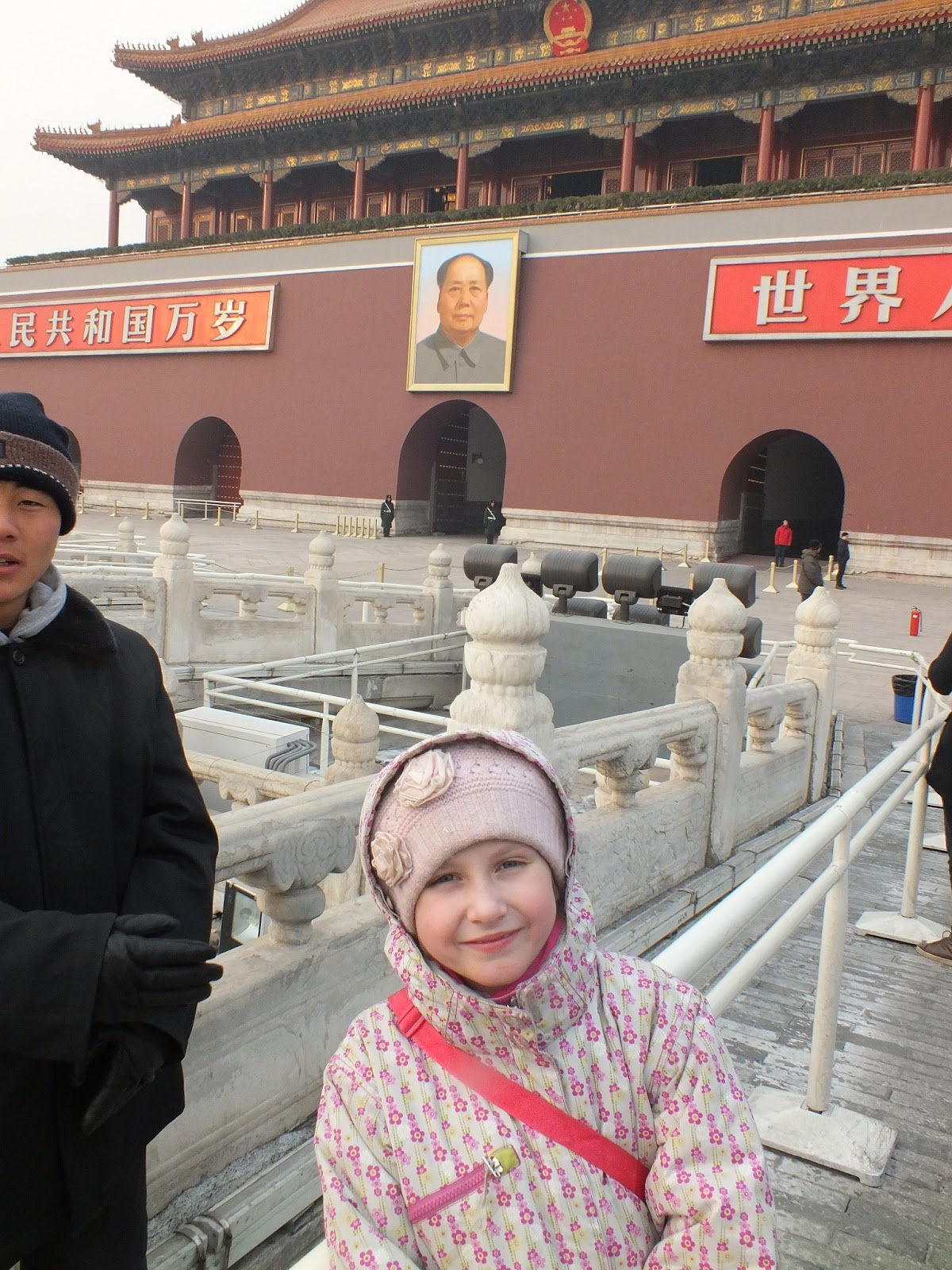
 The actual Forbidden City is at one end of Tiananmen Square, separated by a busy main road. Its design is a series of several pagoda-style gate houses finally leading you to the throne of the Emperor. The first gate house now features a huge photo of Chairman Mao, founder of the People's Republic. Visitors pass through this first gate through a tunnel and into the first huge courtyard. On our first visit, due to earlier winter closing times, this is as far as we got. However the following day we managed to get into the main attraction and walked through several courtyards and gate-houses, taking in the ornate painted woodwork. The official map shows the vastness of the complex, littered with neatly places pagodas, each a sight in their own right. Only the cold distracted from the awe-inspiring reality of being metres away from the seat of the most powerful man on earth for much of recorded history. Time was not on our side and we had trains to catch, so we had to make our way through the complex at increasing pace. You emerge the other end of the Forbidden City somewhat in the middle of nowhere, although having been told the number of the trolleybus we made it back to where we needed to be.
The evening of the first day of our visit, Lawrence and I decided to go and explore the city by night. It was a chance for a little adventure and also for some time to chat. Coming out of the hotel around 10-ish we realised it might be difficult to get transport and the taxi drivers wanted ridiculous sums of money to take us where we wanted to go. In the end we gambled on an electric rickshaw... Quite an experience. He took us along all the backstreets, the traditional hutongs, in the pitch dark. At one point we had a large car very close to our tail. At another he randomly stopped to change batteries. What had looked like fibreglass sides were actually cloth, keeping in the heat, but rather flimsy in the event of a collision (no, we were fine). We finally arrived at our destination, Qianmen street. By the time we got there the pedestrian precinct with a tram line running down the middle and major global brands like Haagen Daas and others, was deserted and closed. However turning off the main street we entered another world - a labyrinth of narrow alleyways packed with establishments selling food. We walked and walked, looking for somewhere still open and finally found a cafe-like place with a statue of Mao and friendly-looking staff. They can't have seen many foreigners because they insisted on taking our picture and asked Lawrence lots of questions about where we were from. The bill for the meal was also a fraction of what we had paid elsewhere and we had plenty eat and lots left over. We made our way back not knowing whether we found find transport, but there were plenty of taxis on the main road and it only cost us half of the rickshaw fare to get back (that's what comes of using the official meter instead of making up the price).

 The next day we got up early for our trip to the Great Wall. I can't imagine there is anyone who has not heard of this great feat of engineering. It isn't disappointing and after an hour or so of driving due north from the city one starts to head uphill until the Wall is visible on the ridge of the mountains. The whole thing took something like 2000 years to build and its total length is over 8800 kms (only half is currently restored). That is something like the entire length of Russia from one end to another... of wall! The Wall, or the bit we visited, is accessible by cable car. The actual Wall, built of yellowy-grey stone, is rather like an extended rampart around a castle - only stretched out in one direction. Every 50 metres or so the wall is interrupted by a sort of turret, which is where soldiers would have been stationed. The edifice snakes off into the distance in either direction and one has a sense both of its magnitude and of the historical significance of this front-line of Chinese civilisation. When it came down to it the Mongols still got through and occupied the throne for a whole dynasty - although they say that it was the conquered who ultimately changed the conqueror and not vice versa. It was one of those sights which it actually doesn't take that long to visit. I guess we could have walked along for some distance, but Sophia's feet were frozen and it was slippy, so having seen it and taken the photos we made our way back.
We said goodbye to Conrad and Jenny in Beijing and headed off for our train back. I will save the account of our second Beijing visit for another post.


