Показаны сообщения с ярлыком English. Показать все сообщения

пятница, 7 февраля 2020 г.

The origin of the Pentarchy (Five Patriarchates)

The earliest churches, founded by the Apostles, were governed by a plurality of elders, as confirmed by church father Jerome in the 4th century.

By the end of the first century the leading elder, who would preside at the church gathering, preach and celebrated the Lord's Supper, came to be known as bishop. It was he who was responsible for receiving, preserving and passing on the Apostolic Teaching.

In a further development the bishop in the capital city of a given province, which was often also the mother church (first founded), came to be known as the metropolitan and had certain rights over the other bishops in his province, who were known as suffragan bishops.

By the third century, the metropolitans in capitals of dioceses (provinces were grouped into dioceses) came to be known as exarchs, mirroring the political structure of the Roman Empire. For example in the diocese of Thrace, the bishop of Heraclea was an exarch, in Asia Ephesus and in Pontus Caesarea.

In 325 at the First Ecumenical Council at Nicaea, after the accession of Constantine, it was ruled as follows: "Let the ancient customs in Egypt, Libya and Pentapolis prevail, that the Bishop of Alexandria have jurisdiction in all these, since the like is customary for the Bishop of Rome also. Likewise in Antioch and the other provinces, let the Churches retain their privileges." (Canon 6)

At the Second Ecumenical Council in 381 it was added, "Because it is new Rome, the bishop of Constantinople is to enjoy the privileges of honour after the bishop of Rome." (Canon 3) The Fourth Ecumenical Council later clarified the jurisdiction of Constantinople, "Consequently, the metropolitans and they alone of the dioceses of Pontus, Asia and Thrace, as well as the bishops among the barbarians of the aforementioned dioceses, are to be ordained by the previously mentioned very holy see of the very holy Church of Constantinople; that is, each metropolitan of the above-mentioned dioceses is to ordain the bishops of the province along with the fellow bishops of that province as has been provided for in the divine canons." (Canon 28) In other words those metropolitans with their see in diocesan capitals (exarchs) of Caesarea, Ephesus and Heraclea were now subject to the higher, ordaining authority of Constantinople.

We can see this pyramid-like structure (bishop-metropolitan-exarch-Constantinople) in canon IX of the Fourth Ecumenical Council: "If any Clergyman has a dispute with another, let him not leave his own Bishop and resort to secular courts, but let him first submit his case to his own Bishop, or let it be tried by referees chosen by both parties and approved by the Bishop. Let anyone who acts contrary hereto be liable to Canonical penalties. If, on the other hand, a Clergyman has a dispute with his own Bishop, or with some other Bishop, let it be tried by the Synod of the province. But if any Bishop or Clergyman has a dispute with the Metropolitan of the same province, let him apply either to the Exarch of the diocese or to the throne of the imperial capital Constantinople, and let it be tried before him."

At the same Council of 451 Jerusalem was granted autonomy from the See of Antioch and "the bishop of Jerusalem, or rather the most holy Church which is under him, shall have under his own power the three Palestines".

These five elevated episcopal sees, Rome, Constantinople, Alexandria, Antioch and Jerusalem, which enjoyed "jurisdiction" and "privileges of honour", were later designated 'patriarchates' by Justinian in 531.

Within the Empire Cyprus had autocephalous (autonomous) status from 431.

Outwith the Empire, the heads of churches were designated Catholicoi (singular 'Catholicos'), e.g. the Sassinian Church or the Armenian Church.


суббота, 2 декабря 2017 г.

Fighting a losing battle?


Image result for losing battleI need to begin by declaring an interest. I am a active minister of religion - Christian to be specific, Baptist to be precise.

I suppose I spend time most days pondering over the issue of being a beleagured minority and whether, in fact, we are fighting a losing battle.

I should actually say that the setting in which I am living and ministering is not secular in the normal sense of the word. While exhibiting other traits of secular societies, Russian society at the present time is increasingly ideological and that ideology is a modern-day manifestation of the age-old Russian 'Third Way', the notion that Russia has a special, spiritual mission and stands alone against its foes, in particular what might be termed the corrosive west, led by the United States of America and Europe. The average Russian today believes in God, professes Eastern Orthodoxy, upholds traditional family values and is patriotically committed to their country and its government.

Fly 4000 km west and one finds oneself in another world. This is the western European culture in which I grew up. Here any notion of religious faith is at best a personal matter and seen as archaic and marginal. Increasingly people have no connection with established religion. And increasingly this passive lack of interest is becoming an active impulse to 'neutralise' the potential influence of the 'foreign agent' which is religious faith. For example, the Republic of Ireland is in the throes of a debate on abortion, proscribed by the country's historic constitution - which is now perceived as being passé and out of touch with the reality of life in the 21st century. Issues of sexuality and gender have likewise become a battleground. However, by no means is the conflict restricted to these spheres. It would seem that as this new worldview evolves and becomes increasingly resurgent it has set its sights on toppling any notion of boundaries and authority, especially anything which comes under the category of 'patriarchal'. O, Brave New World.

So is this all a losing battle? Do the statistics of growing numbers of non-religious people spell the end of religion? Is there any hope for beleaguered, small communities of believers surrounded by hostile societies?

Over recent years I have had the opportunity of visiting Jewish museums, such as that in Moscow and in Vienna. These chronicle the survival of the Jewish people in hostile societies. They are a testimony to the ability of a community to resist what may appear to be an invincible onslaught and attempted assimilation.

Likewise Christian communities, at least so far, have been able to survive in increasingly hostile, non-religious societies. How do they do it?

Perhaps the strongest asset has been a deep-seated sense of identity. In the early centuries Christians would profess before the court, "Christianus sum." Jews know they are Jews. It is who they are. They are inseparable from this identity. If Christians are to survive, it must be the same. Being a Christian, a believer in Jesus, must become part of who I am, rather than something superficial and ultimately separable from me, given the right conditions.

A second, related strength is community. Just as Jews know they are Jews, so they are united to the community of the Synagogue and the Am, the people. Strong communities, one might even say counter-communities represent a real fortress against hostile intrusion. Attendance at weekly services, however well crafted, pales into significance when compared with the wall-to-wall influence of surrounding society 24/7. However, when Christians genuinely live in community, live as an extended family, involved in one another's lives, helping one another, sharing meaningful relationships, then they can survive and thrive.

A third aspect is a combination of what in post-modern parlance has been called meta-narrative and what in Christian jargon is called apologetics. This third aspect is about acquiring and holding a Christian view of the world rather than simply acquiescing to that imposed by the mass media - most often now the internet. It is also about having answers to prevailing, killer arguments of the surrounding culture. There are some great men such as William Lane Craig, John Lennox and Ravi Zacharias who have made it their life's work to publicly defend the Christian faith. And as they do intellectual battle with the heavyweights of New Atheism and secularism, they are well able to stand their ground. Often weak Christians and churches simply succumb to the prevailing narrative of their culture. Sometimes it is as banal as believing whatever they see on TV or read in tabloid newspapers.

Inseparable from all the above is lifestyle. It is precisely here that the church is weakest and most vulnerable. Most people do not leave church and become secular for philosophical reasons. They are far more likely to leave church by succumbing to the prevailing moral weakness of the society in which they live or by becoming like everyone else. Loose sexual mores or downright unfaithfulness, being sucked into the pursuit of possessions and lifestyle, serving Mammon not God with one's time, energy and attention, and an inability to stand and be counted rather than 'blending into the crowd' - these are the causes of falling away from the faith and the church. Likewise, as individuals and families live out the commandments and shape their lives Christianly the pull of the 'world' is much less appealing.
Finally, it is crucial for the church not only to 'defend the fort', but to offer a viable alternative to the surrounding culture. Prevailing churches don't just survive; they grow, as they make converts and see new people added to their number. This does happen. I have seen it happen in all the churches I have been part of - in Belgium, Germany, Britain, Italy, Russia - and in places where I haven't had the privilege of living across all continents and cultures. And I can personally testify to the baptism of Muslims, Buddhists and secularists - to name but a few of the 'unreachable'. 

So is it a losing battle? Well, it is certainly a battle. And many people are losing it. But by no means all people. And half the battle is being able to stand back and see how non-universal and controvertible the prevailing culture and narrative really are. One only needs to compare these with previous ages, when similar forces were being exerted on the church from other quarters. Where are the divine Caesars and the Communist Dawns today?

"His kingdom is an eternal kingdom; his dominion endures from generation to generation."

четверг, 10 марта 2016 г.

Review of National Geographic article, "These 12 Men Shaped Christianity—But Were They Real?"

I have just read an article in National Geographic entitled, "These 12 Men Shaped Christianity—But Were They Real?" by Simon Worrall. It appears to be an appraisal of the work of author Tom Bissell as written up in Apostle: Travels Among the Tombs of the Twelve.


Of course I am biased: I am an evangelical Christian and the article questions the historicity of the Apostles of Jesus. However, having read the article, which will be read by thousands if not millions of others, there are a number of points which I think are worth making. 

1. The article sets out along a time-honoured trajectory reflected in the words, "In Apostle: Travels Among the Tombs of the Twelve, author Tom Bissell sets off to discover whether the Twelve Apostles were actual historical figures or merely characters in a fictional story." An expedition in search of historical truth. However, if the content of the article is anything to go by, the conclusions drawn from this expedition serve only to confirm previously held prejudices. The historic basis for the Twelve Apostles is obviously not to be sought and found in spurious tombs in places such as Spain and Kyrgyzstan. 

2. Many of the phrases in the article reveal an underlying worldview: a lost Roman Catholic faith, a skeptical frame of mind, a simplistic 'laws of science' approach to the supernatural and a predilection for Monty Python's film 'The Life of Brian'. Other phrases such as 'I suspect' and a use of the word 'modern' which just cries out to be deconstructed undermine the article as a piece of investigative journalism. "People’s partisan beliefs that magic and divinity were at work in the world were overriding." Why doesn't that work the other way? Why is it only people in the past whose beliefs are overriding? What about 21st century skeptical, former-Roman Catholics? Don't they have 'overriding beliefs'? What we are dealing with here is not historical research but worldview affirmation.  

3. No actual evidence is presented in support of the claims of the article. Why is it that we should come to the conclusion that the Apostles are mythical figures? Because their purported tombs are not genuine? Because they are not mentioned in secular sources? When the author writes, "As to whether Judas was real, I think it’s probably true that Jesus was betrayed by someone." Are these the conclusions of historical research or hunch-based conjecture?

4. The author writes, "If there had been a New York Times best-seller list in the first century A.D., which column should the New Testament have appeared in? Fiction or nonfiction? I’m not sure if that if a distinction that would have made a lot of sense to anyone in the first century." What? What about Josephus or the pre-first century Wars of Caesar? Did people in the First century not know the difference between fact and fiction? You may not believe the gospels, but it is absurd to assert that they are not written as historical accounts, specifying places, dates, historical figures.  

The Twelve Apostles were historical figures, the disciples of Jesus, who spread the Christian gospel from the fourth decade of the Common Era starting in Jerusalem and eventually reaching as far as places such as Ephesus, Rome and what is now Iran/Iraq. Their tombs are most likely lost and they are possibly not mentioned in secular texts. But all the secular historians I have read are perfectly happy to accept the existence of the Apostles. However much your Catholic schooling may have left you traumatised, you cannot remove individuals from history without leaving a gaping hole. If the Apostles were fictional, you would have to put forward some other explanation for the historical spread of Christianity from Jerusalem starting in the first century AD. 

четверг, 3 марта 2016 г.

Your name is Allah, your name is Ishwar

One of my favourite films is the 1980 classic, Gandhi, starring Ben Kingsley as the leader of the movement for Indian independence from British colonialism. There are many great moments in the film which will remain in my mind and imagination for ever, showing the victory of soul power over the brute force of the British Empire.

One of the aspects of Indian independence and indeed of India to this day is the religious diversity which it encompasses. While not limited to these two religions, India includes both Hindus and Muslims (possibly this is the significance of the colours on the national flag). Gandhi's own fight against state-sponsored racism and for self-determination included a spiritual/religious aspect which both celebrated Indian spirituality and sought to unite the polarised opposites of Hinduism and Islam. No more potently is this expressed than in the bhajan (spiritual
chorus),
Allah tero naam, Ishwar tero naam 
Sab ko sanmatii de, Bhagwan

Your name is Allah, your name is Ishwar
Bless everyone with equanimity, God
(Allah is the Muslim name for God and Ishwar a Hindu name for God.)

If only the intensity of religious devotion could be directed not towards tribal division, but towards harmony and acceptance India would be united and the world a better place.

The sentiment is really powerful. If I may paraphrase for a moment, underneath all the unnecessary divisions there is a simple universality: we are all searching for the same One, however me might name that One. (I suppose it is made more appealing by the possibility of a single individual being known by different names in the same way as, for example, the same person might be Soph, Sophia, daughter or sister.)

However it also seems to me that the variety of names given to the One reflects not the universality of religious experience, but precisely its diversity, a range of different, mutually exclusive answers. It is a nice thought that in the search for meaning 'Everyone is a winner' and therefore religious experience is universal, especially if there is the additional spin-off in terms of national unity and social harmony. For one thing tolerance and harmony is not about all believing the same thing, but about giving someone else space to believe (or not believe) differently, especially if I don't like how they believe or think they are wrong (if we all believe the same thing there is no need for tolerance). But that is a different issue than my spiritual search. If we are genuinely searching for what as a Christian I call God, then I wouldn't want to be too hasty to call off the search, content with what I have found (or think I have found). Who is to say that I have actually found what I am looking for? Who is to say that the name on my lips and in my soul is the One? Maybe that name is an expression of my own search or my own imagination rather than anything more objective than that. If I am engaged in a genuine spiritual quest, then I need there to be a Something the other end, what as a Christian I would call revelation, an epiphany and not merely the rebounding 'ping' of my own prayers and cries.

Jesus' answer is that our spiritual search has failed and that God has himself come to find us uniquely in his person. Jesus is not just one revelation among many. He said, "I am the Way, the Truth and the Life, no one comes to the Father except through me." In his name the nations (in all their cultural diversity) will put their hope. Indeed far from being the figurehead of western cultural imperialism Jesus has been worshipped in places such as India and Central Asia for far longer than in the 'traditionally Christian' English- or Russian-speaking worlds. It is in the light of this that the Apostle Peter boldly declared, "There is no other name given to people under heaven by which they may be saved." The Apostle Paul in a similar vein exclaimed, "At the name of Jesus every knee will bow in heaven and on earth and under the earth and every tongue confess that Jesus Christ is Lord to the glory of God the Father."

In the haunting film, Changeling, a single mother played by Angelina Jolie, returns from a day at work to find her young son missing. She searches desperately. Days turn to weeks and the police efforts to find the boy fail to come up with anything. Then one day the news comes that the boy has been found. The reunion is covered by the press and the successful search celebrated. But it is not her son. Another boy has been talked into pretending to be the lost son in the hope that the distraught mother can transfer her affections and forget her loss, giving the orphan a home into the bargain. However the mother will not be consoled and continues her search, although sadly to no avail (she eventually finds the place her son was held and killed, succeeding only in saving two other boys).

The moral of the story is that for the mother is not enough for her search to find a boy - she needs to find her boy. So also in my spiritual search I don't just want to have a spiritual experience or 'get religion'; I want to find God, I want to know if he is really out there and to hear from him. And if I do hear from him, I don't want to keep that to myself, I genuinely want others to share that experience. A Christian hymn-writer expressed this sentiment over 200 years ago in the following words: "O, that the world might taste and see the wonders of His grace, that the arms that compass me might all mankind embrace." 

пятница, 26 июня 2015 г.

We are all Anabaptists now

In recent days I have been pondering and reading up on a subject entitled, Christ and Culture.

The title is derived from a set of lectures by Niebuhr, who offered five paradigms for the relationship between Christ and Culture, that is to say the gospel/church and the surrounding world. Besides this 20th century seminal text there are earlier works by the likes of Augustine and Luther and more recent books such as that by Donald Carson.

As I have thought and researched on this subject it is clear that whether in Russia, where I serve as pastor, or in Scotland, where we have our 'home church' and many Christian friends, the Christian church is now a tiny minority - certainly less that 5% of the general population. This is a far cry from Holy Russia or indeed Protestant Scotland.

In this context our theology of the church (ecclesiology) needs to match the reality in which we live. We need a theology of the church which acknowledges that we the church exists as a minority within the broader society.

In the 16th century as Zwingli and others were reforming the church and the Roman Catholics were resisting such reforms there was a 'third way' - the radicals or Anabaptists. A lot has been written and said about the isolationism of the Anabaptists and the Amish (an Anabaptist group) have proverbial renown as an anti-example of Christian commitment. However Anabaptists were the ones who, far ahead of their time, recognised that the church is a voluntary society, gathered from society and not co-extensive with it. Facing secularization across the globe we are all Anabaptists now.

The question is how can we exist as a community within society without becoming inward looking and without losing our vision to reach out and draw in "whosoever will". Niebuhr's fivefold thesis was
  1. Christ against culture,
  2. Christ of culture,
  3. Christ above culture,
  4. Christ and culture in paradox and
  5. Christ Transformer of culture.
What relationship matches our setting: Christ in but not of culture? Christ into culture?   

пятница, 20 февраля 2015 г.

Hitlerisation

Let me begin by making it absolutely clear that I am in no way an apologist for Nazism or for Adolf Hitler and for the heinous crimes committed in 1930s Germany and during the 1939-45 World War, not least the genocide of millions of Jews in eastern Europe and elsewhere.


Having said that (and meant it), I want to draw attention to ways in which Adolf Hitler is misused as a means to silence debate, demonise opponents and distort situations. This is a phenomenon called "Hitlerisation".

In may conflicts both sides are quick to tar the other with the "Hitler" brush. Rumours and horror stories serve to shape public opinion and to justify brutality or similar. In many other situations similar rhetoric and labelling is used to great effect. Anything from schools to churches, political parties to multinational companies are compared to the 1930s dictatorship.

So what's wrong with comparing people to Adolf Hitler? I think it would be helpful to be more specific. The Hitler/Nazi phenomenon was quite complex and involved different elements.

  • A populist movement driven by deep-seated anger and maladjustment to the modern world 
  • A cult of personality 
  • Unconstituational centralisation of power 
  • Coercion and violence as means of enforcing the new ideology and regime. 
  • The silencing of dissent, including book-burning and the incarceration of dissidents.  
  • An ideology of superiority (in the case of Nazism, racial superiority) 
  • Demonisation and persecution of minority groups in society
  • An agenda of territorial expansionism 
  • The willingness to lie to achieve its ends. 
  • A propaganda machine, strongly managing truth for ideological ends. 

While by no means acting as an apologist for Nazism, there were positive aspects also. (A relative of mine grew up in 1930s Germany.)  

  • A celebration of national identity and pride, previously humiliated by the Treaty Versailles
  • The promotion of national language and culture in the face of the 1920s/1930s equivalent of globalisation. 
  • Value of parenthood and child-raising (albeit with major qualifications) 
  • Mass employment, albeit in the interests of re-armament  
  • Progress in the field of science and technology, for example rocket science. 

I think it would be helpful to be specific, as to which aspect of Nazism is (allegedly) repeating itself, rather than speaking in emotive generalities.


One specific aspect which I have been thinking about a lot recently is how Nazism saw and portrayed itself as a bastion of moral purity and tradition standing against the decadence of contemporary Weimar Germany. In reality, of course, behind the facade of moral purity was every kind of evil and corruption, including racial hatred and sexual dysfunction (not least in Hitler himself), but Nazi Germany sought to occupy the moral high ground.

I find this intriguing because as an Evangelical Christian I often find myself at odds with contemporary society and permissive ethics. I want to be sure that I do so from a place of love and acceptance for all people (and specifically for those who do not share my lifestyle choices) and also an acceptance and embracing of a changing world to which we must all be constantly adapting and re-adapting. I want to be sure that my own moral choices and stance reflect reality in my own life and not merely aspiration or even denial. I am increasingly wary of us-and-them dichotomies. As Jesus said, "You hypocrite, first take the plank out of your own eye, and then you will see clearly to remove the speck from your brother's eye." (Matthew 7:5) 

суббота, 29 ноября 2014 г.

The Rule of St. Benedict, approx. 547 (review)

I recently finished reading the Rule of Benedict of Nursia, a seminal text in western monasticism. Benedict of Nursia lived in 6th century Italy at a time of war and turmoil as waves of Barbarian invasions filled the vaccuum left by the defunct Roman Empire. This might all seem rather distant from the realities of modern life - or even contemporary Christian living, but I would like to share what I discovered.

The heart of Benedictine Christianity is obedience. "It is by the way of obedience that we go to God." Obedience is contrasted with laziness, but also with self-will. Obedience goes against our fallen nature and requires God's grace. The monastery is to be a School for the Lord's service. 

The Rule is straightforward and moderate. It does not prescribe extreme asceticism, but a moderate form of monastic community life. In many ways it represents a more rigorous version of church; the monk's life being a "continuous lent".  The Rule prescribes a daily routine of prayer and work. Discipline is to be exercised wisely: in proportion to the offence committed and using appropriate means. There are regulations governing the use of common property, the right consumption of food and drink.

The procedure for becoming a monk involved a year-long probation (novitiate) followed by a three-fold vow promising commitment to the monastic community (stability), the monastic way of life (conversion) and the leadership structure (obedience). Abbots (monastic leaders) were to be motivated by the profit of the monks, learned, chaste, temperate and merciful; they are to hate faults but love the brothers. Abbots should strive to be loved, rather than feared.   

The Rule of St. Benedict, an adaptation of an earlier work, became THE authoritative text for the western monastic movement, which in turn exerted an immense influence on the whole of western civilisation, especially from the 9th century onward ("the Benedictine centuries"). 


вторник, 18 ноября 2014 г.

Change?

It's one of those commonplaces so often repeated and cherished among Christians that we all believe it: God has changed my life. 

I remember the testimony of a young Christian who had come to faith through the popular Alpha course. When asked by our pastor what exactly had changed, he simply answered, "Everything."

Twenty plus years later and now it's me who's the pastor. And I don't think it is as black-and-white or as simple as maybe that young Christian made out.

I absolutely believe, not just as an intellectual conviction, but as an observed reality that the God and Father of our Lord Jesus Christ by his Spirit moulds and shapes and transforms personalities and relationships, families and churches. Christians are different. We do have plenty of weaknesses, some of them even exacerbated by aspects of faith and practice. But if I lump together all the thousands of Christians I have met and interacted with over the last 20+ years there is something shared, something all of us have in common which I can only trace to one thing - or rather to one person: Jesus. (Sorry if that sounds trite or sentimental.)

I also believe that such transformation is not instantaneous, nor automatic, nor immediately verifiable. To an extent it can be imitated (faked). In some circumstances it can be learnt. There are plenty of cases where people have genuinely strived towards an ideal of transformation only to find that good intentions are not sufficiently motivating to 'keep it up'. In many cases the old person has never really gone away or been changed. It just takes the right set of circumstances for the sheep's clothing to become detached from the inner wolf. And people revert to type.

So what is it that makes genuine, lasting Christian transformation? What is it that actually transforms a personality so they actually become different, not just trying really hard to be someone who ultimately they are not?

1. I have already said it: Jesus. The Lord Jesus Christ of the gospels. The unique, inimitable, untamable, ever-merciful Saviour of the epistles. The reiging Lamb of the Apocalypse. Lasting Christian transformation is Christlikeness, contact with Jesus 'rubbing off' on someone. Or, in Jesus' words, it is the lasting fruit of those who abide in Him, the True Vine.

2. The gospel. Not the gospel is something other than Jesus. But the gospel in the sense of the core message of Jesus and the Bible which declares the utter failure of the human race in its moral and spiritual endeavour and the invincible mercy of God in doing for us in the person of Jesus what we could not do for ourselves. Humbly relinquishing all pretence and claims before God and gladly receiving the gift of acceptance, renewal, life - that is where the Christian life starts... and where it continues if we are genuinely to grow and progress. The forgiven debtor, the prisoner released on amnesty, the defeated foe accepted onto the winning side. It is in these gospel capacities that we are compelled to action, transformed from the inside out. If you have 'got over' that feeling, then you have stopped growing and changing.

3. Not just learned behaviour or in-group respectability, but a realignment of heart. The person we are, what we are driven by, where our heart wanders when no-one is looking. Means of grace, disciplines and so on are necessary but not sufficient. This can only be the work of the Holy Spirit.

4. Hour-by-hour choices and habits. What we really value is displayed not even by the positive choices we make, but what we say No to. It is human nature to take every opportunity. And why would you turn down the Good unless in the interests of the Better? Real change is reinforced by choices: big choices, but also everyday choices and their accumulated force is to form deep-seated, character-forming habits. When I was coming to faith some words from a preacher challenged me: you haven't proven Jesus is your Lord until you want one thing and he wants another - and you choose His way.   

5. Testing. Our talk of suffering in the Christian life it is often far too generalised. We may all see the merits of suffering, we just don't want it to hurt. The specific trials and difficulties which we face - failures, disappointments, injury, accident, pain, loss, temptation - these are the Fatherly blows discipling the sons whom he loves. And like nothing else they pressure out of us the real motives of our hearts and purify us as in furnace. We can all tell - in ourselves and in others - the difference between a truth understood and a truth undergone. Martin Luther well described the three qualities of a theologian as prayer, reflection and Anfechtung (spiritual battle).

6. Time. Someone has said that the only Christian grace which cannot be imitated is perseverance. Probably even perseverance can be imitated in the sense that we can conceal faults and inconsistencies to the grave. But time sifts much of the wheat from the tares. Jesus spoke of lasting fruit; he also taught about the temporary fruit of the seed which fell in the shallow soil and in the stony ground. Only time showed the difference.

These are some of my thoughts about change. I may have others, but I thought I might share what I have.   

вторник, 7 октября 2014 г.

What is truth?

I have been thinking a lot about truth recently. 

The obvious reason for this is the crisis in eastern Ukraine which has spawned two rival perceptions of reality.

The dominant view in Russia, held by virtually everyone, is that Russia is being bullied by the west and its agenda of expansionism. The west has orchestrated a coup d'etat in Ukraine, so the story goes, with the aim of bringing Ukraine under its sphere of influence (NATO, EU). Russia has refused to take this onslaught lying down and has been forced to respond at least in the form of tacit sympathy for its compatriots in eastern Ukraine. Bombed by its own government the Russian-speaking population in what is now referred to as Novorossiya is having to defend itself and is justified in doing so. Their desire for autonomy or union with Russia is being hypocritically denied while elsewhere Scotland and Catalonia are free to hold independence referenda. Some even see this confrontation in broader terms as a stand-off between the decadent, liberal west and Holy Russia, the last bastion of conservative Christian values. Russia, in the form of international vilification and potential economic hardship, is now suffering the consequences of western agression and hypocrisy. But, as the local saying goes, "Russians don't surrender."

No doubt most readers of this article will be well-acqainted with a quite different spin on the same events.

Both sides are absolutely convinced that they are right.

So, to quote Pontius Pilate, "What is truth?" Is there such a thing as truth? Can there be any sort of objectivity?

First of all, there are clearly certain factors which make it difficult to 'get at' the truth.
1. For one thing, people believe what everyone around them believes. Any society has its commonplaces, its shared values and beliefs. At the heart of such shared beliefs is possibly always a deep-seated convinction of one's own vindication. In the words of the Scottish poem, "Wha's like us?" Having repudiated the imperialism of the past the western nations nevertheless hold that certain 'values' are universal and need to be shared by all, while Russia believes that its particular brand of managed democracy and patriotic values is what is required to keep the liberal rot at bay.
2. Secondly, people believe what they see on television. Mass media are a very effective means of communicating both news and opinion. Carefully chosen, emotive words combined with images appealing to deep feelings such as pity and hatred are a strong force which few can overcome. In George Orwell's 1984 the Two Minutes Hate was a powerful tool for sublimating primal instincts along party lines. News stories play to stereotypes, portraying political figures in caricature terms and dividing the world into 'goodies' and 'baddies' with one's own interests and values predictably on the side of the 'goodies'.
3. Thirdly, however they have come to such views, people have an in-built resistance to revising those views, even when reason and common-sense seem to point in the opposite direction. It is by no means a rare occurrence for someone to, as it were, look the truth in the eyes and deny it.

So what hope is there of arriving at some sort of objective truth? Is it indeed impossible to persuade anyone of anything? And if one were to do so, might there not be a risk that factors other than the truth itself might be decisive in persuasion?

As a Christian, I believe the words of the gospel: "Nothing is covered up that will not be revealed, or hidden that will not be known. Therefore whatever you have said in the dark shall be heard in the light, and what you have whispered in private rooms shall be proclaimed on the housetops." (Luke 12:2-3) William Shakespeare expressed a similar thought with the words, "Truth will out." Or, in the famous words of Abraham Lincoln, "You can fool all the people some of the time, and some of the people all the time, but you cannot fool all the people all the time."

How might this work?
1. At first glance it might seem plausible that people can believe what they like and no one can tell them otherwise. However there are various factors which can chip away at such feet of clay. Consistency. Plausibility in the light of other knowledge. The views of others (even if they are in a minority). The quiet voice of past experience and history. In 1914 stories of German atrocities in Belgium drove many to sign up as soliders; by 1928 the same propaganda stories were transparently tools used by the government to justify the war.    
2. For another thing maintaining a party line requires a lot of effort and can only be kept up for so long. I am reminded of embattled hotel owner Basil Fawlty (in the 1970s comedy, Fawlty Towers) and how his efforts to hoodwink his wife gradually unravel as a given episode progresses. Given enough time and people it becomes increasingly difficult to maintain a false alibi. Sometimes a change in circumstances can provide the jolt that 'breaks the spell'. 3. Thirdly, I have found that a powerful tool in persuasion, rather that attacking someone's view, is to get them to explain it to you, even to convince you. It is one thing to passively hold a given view. It is quite another, and more demanding, to actively propagate it to others. On more than one occasion I have changed my view on a given issue in the process of explaining it to someone else. Anyone who has done any teaching will relate to having to relearn things or fill in gaps in one's knowledge in order to be able to pass it on to others. 

четверг, 27 февраля 2014 г.

Don't mention the war... the Cold War

(Writing in 2022, I regret to say that my blog post below, while making some valid points, has proven disastrously wrong in the light of the events of 2014 and later 2022.) 

It's been quite an eventful few weeks in the former Soviet Union. Not only have there been the Olympic Games in Sochi, but Russia's closest neighbour, Ukraine, has experienced a revolution.

In the run-up to the Sochi games no holds were barred with comparisons to Berlin 1936, fears for discrimination against same-sex relationships, terror threats and hyper-sensitive journalists stirring up stereotypes about poor Russian service. While very expensive, the consensus view is now that the Games were a fantastic success, very well run and provided a great forum for sporting competition. And an added bonus that the host nation topped the medals table fair and square. For me it was worth it just for the figure skating and the cross-country relay events. No sign of any major apologies after some pretty appaling journalism and despicable attempts to disrespect the host nation by sending low-key delegations hand-picked to highlight non-Olympic agendas.

Meanwhile in Kiev, perhaps not entirely by coincidence, the long-standing tensions between Ukrainian-speaking north west and the Russian-speaking south-east turned into a nasty stand-off at the Maidan independence square in Kiev, resulting in the overthrow of the president, Yanukovich, and now knock-on effects in Crimea and possible elsewhere. I am the last person to justify the use of snipers on a crowd of civilian demonstrators, however provocative, but no one in their right mind wants parliaments with powers to remove elected presidents or annul legal sentences by a show of hands in the space of hours. (Just imagine what would happen in the US if Congress could remove the President by a mere show of hands or, indeed, override the judiciary as it saw fit.) And I am very uncomfortable with the equation of good and evil, freedom and tyranny with the respective sides in an ethnically complicated country like Ukraine.

And so, it turns out, people haven't got over the Cold War yet. Certainly not the victors. Like chauvinstic hotel-owner Basil Fawlty from the 1970s British comedy, the Old Enemy remains although the conflict is decades in the past. The prejudices about Russia, Russians and the Russian President remain and are daily reinforced by the media.

Meanwhile in Russia everyone has Ukrainian relatives and forebears. Russia and Ukraine might be different colours on your map, but they are not separate, non-communicating entities. It was bad enough when Georgia was estranged from her long-standing ally, but Ukraine is a hundred times worse. A peaceful outcome to the events in Ukraine and long-term progress in relations between NATO-EU and Russia will hinge on the ability to respect and listen, not dismissing Russia as a passe bully who can be ignored and resisted because one now has 'playground protection'. International partnership in the 21st century cannot be doing with the Old Colonialism, even in its latest liberal democratic guise.

The Cold War is over. Get over it.     

пятница, 7 февраля 2014 г.

Burn, heretic? (the Alexandrian library and its lessons)

There was once a huge library in the Egyptian city of Alexandria. It was founded by the Ptolemy I or II in the 3rd century BC and was at the height of its development up until about 30 BC. The Alexandrian library was a storehouse of ancient knowledge and would have included a copy of the translated Old Testament Scriptures (the Septuagint) as well as countless works of art and science. It was later moved to a pagan temple, the Serapeum. There are various versions of who burnt it down: the Romans (AD 48 or AD 270s), the Muslims (642), but - I am ashamed to say - the Christians were also implicated and it may have been the Coptic bishop of Alexandria, Theophilus, who in 391 ordered or turned a blind eye to the burning of the library, by the Christian mob (including monks)

What is the significance of the burning of the Serapeum?  

As an amateur historian and also as a Christian who believes in tolerance this act makes me very uncomfortable. But, perhaps more than that, I think it reflects a certain train of thought which is dangerous both within the church and without. And it can be summed up in a sentence, "I am right." Now, don't get me wrong; I am not a relativist. I don't believe that the truth doesn't matter, nor indeed that the truth is not knowable. I believe that Jesus is the Way and the Truth and the Life. But I am also aware that once someone gets it in their head not just the truth is knowable, but that they - personally and in principle - are right, something goes wrong

For one thing I don't believe that my faith excludes truth outside the confines of those who share it. All truth is God's truth. And there is much that is true and praiseworthy which is not Christian. Because God, as well as being the Saviour of the church in Christ is also the Creator of all through that same Christ. And to deny - or even be suspicious of - everything outside of the church is to deny that God is Creator. If you want to give it a scary name it is crypto-gnosticism. What's more just because the truth is in Jesus, doesn't mean my knowledge of it is infallible or complete. 

That means that I have got to keep listening. Listening to God in his Word. But also listening to people who disagree with me and whom I disagree with. I can't disount them and their views ("They would say that, wouldn't they!"). I can't isolate myself in my own in-group. If I do so it is bad for me and for others. 

Now, the problem isn't just in the church. There are other in-groups which share values and a meta-narrative and which are in danger of closing themselves off - or of trying to strongarm everyone else onto their side. You know who you are. Richard Dawkins fans. The LGBT community. The PC and equality lobby. The family values conservatives and nationalists in various guises. There are others. 

I think the lesson is this: don't stop listening to those who disagree with you. That dissenting voice is good for you. Embrace it, even if you don't agree with it. 

четверг, 23 января 2014 г.

Ministry principles for cross-cultural Christian workers

I am a seasoned 'alien and stranger'; I have spent 24 of my 39 years abroad (Belgium, Germany and Russia). And since I first worked with OM in 1992 I have spent over 10 years as what some people would call a 'missionary' (cross-cultural Christian worker).

I would like to share some principles which I have learnt and try to put into practice over this time. For the most past I owe these to OM and IFES, but have also benefitted from the sterling work of the Lausanne movement and the example of many unsung heroes of cross-cultural mission.

So here they are:

1. Enjoy it. There is no merit and little to be gained from a 'burning martyr' approach: hating every moment of being abroad, feeling sorry for oneself. If God has called you somewhere, embrace it, enjoy it, learn to like it.
2. Learn the language. Not everyone has the benefit of learning languages from a young age and some people find grammar etc. more difficult than others. But the experience of world mission is that any human language is learnable over 1-2 years in-country. You are not more stupid than everyone else. But you need to get the exposure to the language, so don't huddle together with other foreigners or sit inside. Languages are learnt socialising, not buried in a Teach Yourself book.
3. Love the people. God loves people - that's why he sent Jesus. Treat any misanthropic tendencies as sins to be mortified. As the 1980s song goes, "Love is the message and the message is love!"
4. Embrace the culture and go native. Every culture has its plus points and perks. It's exciting to find them and to embrace that aspect of God's goodness. Most people find that in a foreign language their personality is a little different - embrace it (while not abandoning your own nationality and culture).
5. Be part of the local Body of Christ. The church of Jesus Christ is made up of every tribe and people and language. And as a cross-cultural worker you have the opportunity of experiencing this variety first hand. Don't be so tied to form that you can't worship God in another language and cultural medium. The chances are that the host culture will open up new vistas on God and his Word, if only you are willing to see things from another viewpoint.
6. Submit and be flexible. Countless workers and projects flounder because they try to bulldoze through their way of doing things with them in control. It doesn't take that much effort to listen and observe, take advice and be willing to adapt. And it is only good manners to submit to local leadership even if you don't always agree 100%.
7. Find out what you can contribute and give 100% to the Lord and his people, not trying to prove yourself and make people grateful (that's a guaranteed path to disappointment and resentment).
8. Be willing to receive. There is no greater missionary pride than the 'benefactor syndrome'; the cross-cultural worker who always has to be the one with the money, resources and opportunities. There is nothing more humbling than gratefully receiving help.

"Surely the Lord is in this place and I was not aware of it." (Genesis 28:16)  

четверг, 16 января 2014 г.

Vignettes of winter in Siberia


It's actually been quite warm this year. But for two brief cold snaps (when the temperature dropped to minus 30 Celsius) most days we have been enjoying a balmy minus 7 to about minus 12 . We haven't had a lot of snow (not nearly as much as last year (photo).

All the same, there are some aspects of everyday life which are part and parcel of living in Siberia, but which might be unusual and interesting to those who dwell in milder or warmer climes.

Here are a few:

  • The first thing Russian schoolchildren do when they get to school is take off their winter coat, winter hat, scarf, stockings and boots and leave them in the school cloakroom. 
  • Cars can cope with the cold, but add 10-15 minutes to your journey time to allow the engine to warm up, to scrape off the ice and snow and to shovel any snowfall. If it's really cold you will have to disconnect the car battery and take it inside overnight, so the car starts the following morning. 
  • In case you car gets stuck in snow or ice, make sure you have a spade, a towing rope (I actually had to look that up; I only know the Russian word!) and, if necessary, wooden boards (the studs on the winter tyres need to grip something to get out of wherever you are stuck).  
  • Never go outside without a good winter hat, scarf and warm boots. 
  • Forget skiing and sledging: real Russian fun is the 'zimnyaya gorka' or ice slide (no, it does not comply with EU Health and safety). Climb to the top and slide down 10 metres on your bottom or a piece of cardboard.  
  • If you don't have a fridge (eg in a student hostel), just put your milk, butter and whatever else in a plastic bag and suspend out of the window). But don't leave potatoes out on the balcony, as they will freeze and be spoiled. 
  • Russian homes are always warm from October to May and throughout the whole 24 hour cycle (of course there are exceptions); we find it very cold at night when in the UK, as the heating only comes on in the morning. 
  • A full-on Russian experience (enjoyed by all genuine mujiki) is the banya - a steam bath. In the winter you should run out into the snow mid-banya to cool down. 

понедельник, 3 июня 2013 г.

A brother in Christ, but misled and misleading (David Pawson 1930-2020)

I have just heard the sad news that a prominent minister and brother in Christ, David Pawson, has died. I wrote the piece below some years ago, and recently revisited it, considering whether Christian charity demanded that I remove it. However, I think I make clear in the introduction and throughout that I accept David Pawson as a "Christian brother and not a heretic." At the same time major parts of his teaching are wrong and potentially damaging. 

Browsing youtube.com I came across various clips by a charismatic pastor called David Pawson, whose books many will have seen on the shelves of Christian book stores. David Pawson wasn't one of those wild charismatics prone to shouting or getting people to fall on the floor. Nor was he 'on the make' preaching health and wealth. However, while he was a Christian brother and not a heretic, nevertheless major emphases of his quiet, thoughtful, apparently Biblical message are also wrong and damaging.

Around 1993, when I was an undergraduate student at university, David Pawson made a great impression on me. He explained the truth of the Christian faith in simple and memorable terms, referring both to the original languages of Hebrew and Greek and to church history. Or so it seemed. His simple logic led to straightforward conclusions, not least justifying the so-called baptism in the Holy Spirit and the church practice of the charismatic churches in which he had found his spiritual home (having previously been a Methodist and a Baptist). Accepting his teaching for a short period I came to believe that I was not yet a Christian in the full sense of the word and I awaited a particular experience which would finally usher me into the fullness of the Spirit. God, graciously, did not answer my prayer. If he had granted my request I am sure I would have imposed this view on others, unchurching all of Christendom.

At the time I was helped my best Christian friend and, later, by my own study of the Bible. I came to see that the case David Pawson was making started with a particular conclusion (for example the experience of the baptism in the Spirit) and then read it back into the book of Acts and the epistles. The use of Greek words or references to church history were smoke and mirrors. And they served to distract my attention (and no doubt of thousands of others) from the central truths of the gospel. Once I was able to study the Bible proactively (eg 1 John), the conclusions in David Pawson's books were not only absent; they were directly contradicted.

For example, answering the question, "What is the normal Christian birth?" David Pawson answers: repent, believe, be baptised and receive the Holy Spirit (four steps).

What is missing from that list?

1. First of all the absolutely central place of God's preached message of the gospel. By focusing on 'steps to be born again' the preached message becomes secondary, a sort of explanatory warm-up for the real event: my steps towards God. Notwithstanding the order of events at key turning points in the history of the church (Pentecost, the Samaritans, Cornelius), there are instances in the book of Acts of new birth before baptism or without the outward signs, but never without the preaching of the Word.

2. Secondly, the reality is that salvation is not what I do (a series of steps), but rather I receive salvation (or am receiving salvation) as I respond to the saving grace of God. There is a simplicity and unity to this response (think of Abraham's 'amen' to God's promise in Genesis 15), albeit at times spread out over time and with various aspects. For example, John Murray (Salvation Accomplished and Applied) speaks of this response in terms of repentance and faith not as two distinct 'steps' but as penitent faith and believing repentance.

3. And thirdly, there is no mention of the signs of Christian life: the basic Christian virtues of faith, hope and love; the various 'tests' in 1 John. While a tenuous case might be made that, like the Samaritans, someone might believe but not yet have received the Spirit, a life bearing the fruit of the Spirit is a sure sign that a non-charismatic believer is not still stuck in the delivery room.

Twenty years later listening to an elderly David Pawson his limitations as a theologian were more apparent to me. He did refer to individual Greek words, but not to the language as a whole. His references to church history were snippets rather than comprehensive. And cliches such as the Hellenisation of the Christian faith risk being generalisations, rather than the fruit of in-depth study. David Pawson was not an academic, and his audience was not in a position to critique or question what he was telling them. In academic parlance his teaching was not peer-reviewed. And his burdens and special revelations from God just didn't 'do it' for me any more; these were the product of his own mind and experience, not words from God.

So why was David Pawson so convincing? Why then and why now?
1. Firstly, while David Pawson was better read than his audience, that doesn't mean that the positions he adopted were authoritative. It is the responsibility of every Christian believer to know what they believe and why they believe it, to have some basic grasp of the Bible and of church history to be able to test and discern teaching. 
2. Secondly, there is a phenomenon akin to "preaching to the choir". As long as one is content with 'life as it is' in one's own denomination, ignorant of anything outside, then apologies for the status quo will be appealing. We all want to be told that what we are doing is right. In one talk David Pawson suggested the Didache (an early church text dated to the first century AD) offered the model of a 'teaching session' followed by a 'time of worship'. In case you missed it, he is referring to the liturgy of the Word followed by the liturgy of the Eucharist! In other words it read into a 1st century text the culturally bound practice of 20th/21st century evangelical charismatic churches. You need to get out more!
3. Thirdly, some of the positions he espoused appealed to lazy, anti-intellectual instincts. If only it was all about having the right experience wouldn't things be simpler? It's a Christian version of the unexamined life.

Let us remember David Pawson for his Christian life and the truth he believed, while at the same time, "Brothers, keep yourselves from idols."

David Pawson 1930-2020 May he rest in peace and rise in glory

среда, 23 января 2013 г.

Impressions of China (Part IX): our last day in China

We woke early on 2 January to catch our train to Beijing with less that 24 hours to go before our flight home. Oxana did a good job packing our bags and cases and I got all the money and various documents ready for travel. What I didn't remember to do was to charge the iPad and the mobile phones. Mistake! We only realised this once we were on the train.

I have already written about the bullet train which connects Jinan and Beijing in under 2 hours. Very efficient and comfortable. And not withstanding our rather bulky luggage (with five of us we have a baggage allowance of 100kg but only two of us can actually carry stuff) we made it by taxi to the station and to the waiting hall with some time to spare. We said goodbye to Lawrence and Miao Miao in order to go down to the platform - we had said goodbye to Leo the previous day; we was staying with his Chinese grandparents and his cousin and friend, Jiao Chang.

The train journey was quite calm. We only discovered the uncharged equipment gradually - and were lulled into a false sense of relief when we were able to charge the iPad and Mum's phone in the carriage. It was only after we arrived in Beijing that we discovered our phone was down - and we were planning to split up later in the day.

Arriving in Beijing, we found the taxi rank and headed off for the airport. We had down all the ground work on our previous visit and knew where to go and how much approximately it would cost (about 100 RMB = 10 GBP).

On arriving at the airport we knew to make our way to the 'Aule lounge' which actually turned out to be the 'Hourly lounge'! At this point we were hoping to be able to check in, leave our luggage and relax for the rest of the day. However the booking arrangements were rather strange. Overnight accommodation was only available after 6pm and all the day-time rooms were full. We had to hand our belongings in at 'left luggage' and plan to be back dead on 6pm in the hope of being able to get a space.

The airport is connected to the underground network by a rail-link. We purchased our tickets and headed into town with about 2-3 hours for our tourist visit. Oxana, not having been with us on the previous trip, wanted to see the Forbidden City, while we were keen to visit the zoo and the Pandas. We separated paths slightly nervy with the phone not charged (there was very little battery left). Mum, myself and the three girls took the underground towards the zoo.

Beijing Zoo was great. It was Baltic - and we were frozen by the end of it - but we did find the pandas and spent most of our time seeing them and taking photographs. There must have been about 5 of them in various glass cages and outside. One amusing moment happened when a Chinese student, standing with her back to one of the world's rarest species, asked to take Sophia's photo. White-skinned non-Chinese Europeans are a rare species to the Han Chinese - even in cosmopolitan Beijing!

Time was catching up on us and although we did attempt to find the dolphins and then the giraffes, they were located at the far end of the zoo and various things were closed or inaccessible. In the end we started to make our way back to the airport, but not before Oxana rang to say she was lost and her phone was already virtually out of power, ruling out calling Lawrence and Miao Miao for help (in the end she was helped by some sort of 'citizens' patrol' which reminded Oxana of the good old days in the Soviet Union). It was a rather anxious trip back on the underground and rail-link and we were grateful to see Oxana when we got back. In the event the Hourly Lounge did have availability and we were able finally to dump our bags and relax.

We decided it would be nice to go for a meal together and had a mind to print off our boarding passes. Our meals were fine - generous bowls of noodles in a soya soup, but Mum's non-noodle meal was rather meagre. We then attempted to get some deserts elsewhere - and Mum something more substantial, but to no avail, as there was either very little selection or ludicrous prices. And you couldn't print your boarding pass at the airport for love or money. Even the office which did offer to print off allegedly didn't have internet access. After much ado - and a phonecall to S7 airlines Chinese office - we abandoned the undertaking. In the end I got Lawrence in Jinan to check us in online (although we didn't have a print out to prove this).

At the end of the evening I went for a coffee and a chat with Mum before retiring to bed.

The next morning began at 3am. On awaking I remembered that we needed our housekeys. You can imagine the increasing panic as they were not in the obvious places (where I thought I had left them). I was desparately rifling through all the bags, but no joy. To make things worse my call to Lawrence to book onto the flight had finished off our mobile credit, so we couldn't text folk in Siberia to make arrangements (as far as we knew our spare keys were a three-hour train's ride away from home!). Feeling suitably despondent we realised that if the keys were indeed with us we hadn't lost them in the room and we made our way upstairs for our flight. Mum had kindly awoken and said goodbye to us all. Before we checked in we had an unfortunate attempt to get our bags wrapped in cling film, falling victim to some scammers who pretended to be official aiport staff. The airline and airport stuff were unable to grasp what we were trying to explain; in China 'a little' English means just that. There wasn't much we could do and the scam had only really cost us 5 UK pounds. We had a nice final photo taken in front of an interesting sculpture in the terminal before heading off to the gate. After some hurried duty free shopping we were the last on the flight, which turned out to be virtually empty (20 or so folk).

The flight was quite relaxed... and in the relative calm I found the keys (in the blind panic earlier I had not properly checked one of the pockets on the suitcase). We arrived in Novosibirsk having had a half-decent sleep and kindly met by Alex Richardson.


And so ends our trip to China. 

вторник, 22 января 2013 г.

Impressions of China (Part VIII): Historic sites and Buddhist temples

We woke up on New Year's Day 2013 in China. Mum and Lawrence had been looking after the girls, so we had a nice lie-in. This was to be our last full day in Jinan, before heading back home via Beijing on 2 January. Lawrence rang to make sure we weren't too late, as my sister-in-law, Miao Miao, was keen to show us one more tourist sight before we left.


Earlier on our visit Miao Miao's Dad had shown us around the historic centre of Jinan: Daming lake. This bascially consists of a large park area enclosed by remains of the old city wall with a lake in the middle surrounded by various old buildings, including Buddhist temples. As in Beijing the layout is very open with wide spaces. The old Chinese buildings are pagoda-style and made of brick with intricately carved and painted wooded roofs.

To the untrained Judeo-Christian eye Buddist temples centre around a statue to which worship is offered in the form of incense sticks, other gifts and by bowing down, often with hands held together in a prayer-like gesture. It is difficult to tell, as we didn't get to ask anyone questions, but it would seem that the religious devotion is driven more by specific personal needs than by a sense of worship per se. Chinese, while very contemporary and holding to a scientific worldview, are quite superstitious and attach a lot of importance to the number eight and the colour red. A local custom is to attach red ribbons to special trees as a token of luck.


On the final day of our trip Miao Miao took us to a Buddhist site on the mountainous edge of the city. The complex was rather like a large park. We climbed up the hill and then walked down the hill among various very large statues of Buddha and other related figures, including a female representing kindness. For most of the visitors, possibly including us, the spiritual/religious aspect was incidental and on the square in front of a HUGE and apparently well-fed Buddha (right) were various go-carts and similar rides for children. While there were cushions for genuflexion and a tray for incense sticks in front of the statue, the overall ambience around the statue was more of a day out than worship or religious devotion. It was standing in front of this Buddha that Miao Miao starting to ask me probing question about faith and whether all the religions were not indeed the same.


The central piece of Buddhist site was the cave of ten thousand Buddhas, which basically did exactly what it says on the tin. The cave has obviously been renovated as a tourist site and is a warm, well-lit tunnel decorated by ten thousand (or certainly a very large number) of Buddhist statues. This part of the complex was more conducive to devotion and culminated in a shrine chamber where people were clearly earnestly engaged in acts of worship.

After the park we returned home to a meal of home-made Chinese dumplings and other food. If it weren't for the intenstinal after-shocks of our 'steak' house meal a couple of days before, we would have had a larger appetite, but it was tasty all the same. We were able to spend some more time with Miao Miao's parents and her sister and family (the latter all speak English) and to present some gifts from home.

In the evening I spent some time with Mum and Lawrence, going for a foot massage and then for a few games of pool with Lawrence. All good. I got to bed quite late and we had an early start catching the train to Beijing the following morning.


воскресенье, 20 января 2013 г.

Impressions of China (Part VII)

We arrived back from Beijing late on Friday evening; snow delayed the train by about an hour as we left late and travelled slightly slower. We only had a few days left in Jinan, as we were due to fly back to Russia very early on Thursday morning and Wednesday would be spent travelling to Beijing.

This symbol means horse and is pronounced 'ma'
As I have already said I made a concerted effort during my stay to make something of the Chinese characters and by the time we left China I could recognise and pronounce maybe 30 or so. It is estimated that about 2-3 thousand are required for functional literacy, but some are more commonly used than others and with my very limited knowledge every second or third sign made some sense.

My very limited knowledge of Chinese did not help me much when I went for a haircut. In future I will plan these things better and pre-empt particular situations. Basically, I just walked into the local hairdresser with mum and signalled that I would like a haircut. This prompted a mild panic and the obvious question, "Do you speak Chinese?" Having given the less preferable answer and when my brother Lawrence was unable to help over the mobile, I was invited to sit down and was given what I shall call a shampoo massage by an attractive female hairdresser. Somewhat embarassed and also aware of the potential cost I signalled that I wanted my hair cut (scissors gesture) and was whisked away to have my hair rinsed. The rest of the haircut was done by a male hairdresser. He asked the obvious question, namely, "What do you want done?" I hadn't planned this far ahead. A succession of outlandish Chinese hairstyles were flashed in front of me until we came across the nearest thing to front, back and sides (I exaggerate) - which I opted for. In the end it was rather short, but looked fine. There was also an 'ET' moment when one of the hairdressers pulled out Google Earth on his IPad and asked me where I was from. The simple explanation was to say 'Edinburgh'. Introducing Novosibirsk into the equation would have made things too complicated. There is only so much you can explain without words.

The next day Kiera and I went out exploring the town on the bus. We travelled into town and then walked around, finding a less up-market shopping street cum market and then finding ourselves near a shopping centre we had visited earlier. From here we jumped on a trolleybus, guessing that the overhead cables were more likely to take us straight ahead; our aim was to find the Chinese church we had attended on Christmas eve (photo right taken at night). We had not managed to make the morning service, and I was hopeful that maybe we could meet someone later on Sunday. We did find the church (I told Kiera to shout out when she saw a big cross), but it was all locked up and despite us hanging about for a wee while, no one came out and we went on our way. Once Kiera had exacted a present from me (princess set including battery-operated wand) we caught a taxi back to Lawrence's.

That evening we went out with Lawrence and Mum to another shopping centre, paying for the children to be in the play area and then went for a meal at the 'steak' house. The inverted commas around the word steak are largely due to the food poisoning Oxana got from her dodgy bit of beef.

The next day we travelled to the Zoo. It was rather cold again, although the day did turn out quite nice and we saw lots of animals and the children enjoyed it. Lawrence donned by Russian ushanka winter hat and did a very good impression of me. By this time it was rush hour and we spent ages getting back home in a very full bus, Kiera falling asleep on a step.


It was New Year's eve, which, much like 25 December, is not such a big deal in China. We decided to order KFC which combined with various snacks and fruit accumulated over the last few days was our Hogmanay meal (= 31 December). Oxana and I went off to see in the New Year together which Lawrence and Mum looked after Sophia, Kiera and Tanya. We didn't do anything wild - just saw in the New Year watching Chinese TV, trying to catch familiar words and characters on the screen. All very show-bizzy: boy bands and choreographed dancing troops performing to rousing tunes - patriotic but not political. Pictures of New Year then came in from various locations around China, including Taipei (capital of Taiwan, which is not officially recognised by the People's Republic of China).  

суббота, 19 января 2013 г.

Impressions of China (Part VI): Beijing

Having visited other world cities - London, Paris, Berlin, Milan, Rome, Moscow and now more recently Istanbul and Toronto - we were very keen to see Beijing. We almost didn't make it due to problems buying tickets and concerns about the children, but in the end we were able to make two short trips. We didn't regret it.

Sophia and I travelled to Beijing by bullet train. The Japanese-style trains - with airport-style train stations to match - were absolutely fantastic. We were travelling at 300 kmph for two hours in comfort for 20 pounds return. Very convenient and a classic example of the New China.

Beijing is not the ancient capital of China and, if memory serves, it has only been the capital city since the times of the Mongol ascendency in the 13th century, which incidentally coincided with the visit of Marco Polo. However that takes nothing from its stature and magnificence in today's China and today's world. 

The population of the city, whose name means 'Northern Stone', is around the 20 million mark. The smog problems publicised at the time of the 2008 Olympics and in the last few weeks were not a problem when we were there, however one is aware of being in a huge metropolis. Old and new peacefully co-exist, with vast housing complexes and commercial tower blocks intermingled with ancient pagoda's and the traditional hutongs (low-rise housing connected by narrow alley-ways). Beijing, particularly the centre, doesn't feel claustrophobic or excessively built-up. In fact there are lots of open spaces and a lot of the buildings are not particularly tall. 

Tiananmen Square
Our hotel, courtesy of Conrad and Jenny, was the Peace Novotel near the Forbidden City. The rooms were very comfortable and warm (we had become accustomed to being cold inside). It took us maybe 40 minutes by taxi to reach it from Beijing south station. Having left our belongings we made our way off towards the central sights. We stopped on the way to have lunch, which rather surprisingly was not unduly expensive and we were able to enjoy the privacy of a separate room. The usual fare of rice and accompanying dishes - all very tasty. We then made our way by foot to the forbidden city along a minor road lined with one-storey buildings with plenty of souvenirs for sale. It took longer than expected as the 1.3 km distance from the hotel did not take account of the entrance to the Forbidden City being at the other end.

As you walk onto the main thoroughfare you can feel the approaching immensity of Tiananmen square

For those who have been to Moscow, the parallel is Red Square - a huge expanse in front of the royal citadel (which is basically what the Forbidden city is/was), however multiply by at least two and add in the weight of history, the size of China and the events of 1989. The police presence is heavy and visible. Chinese are stopped and their ID card numbers registered in handheld computers. Bags are searched and to get onto the actual square, scanned airport-style. The entire space is covered with cameras which follow people as they move around. No one is taking any chances. 

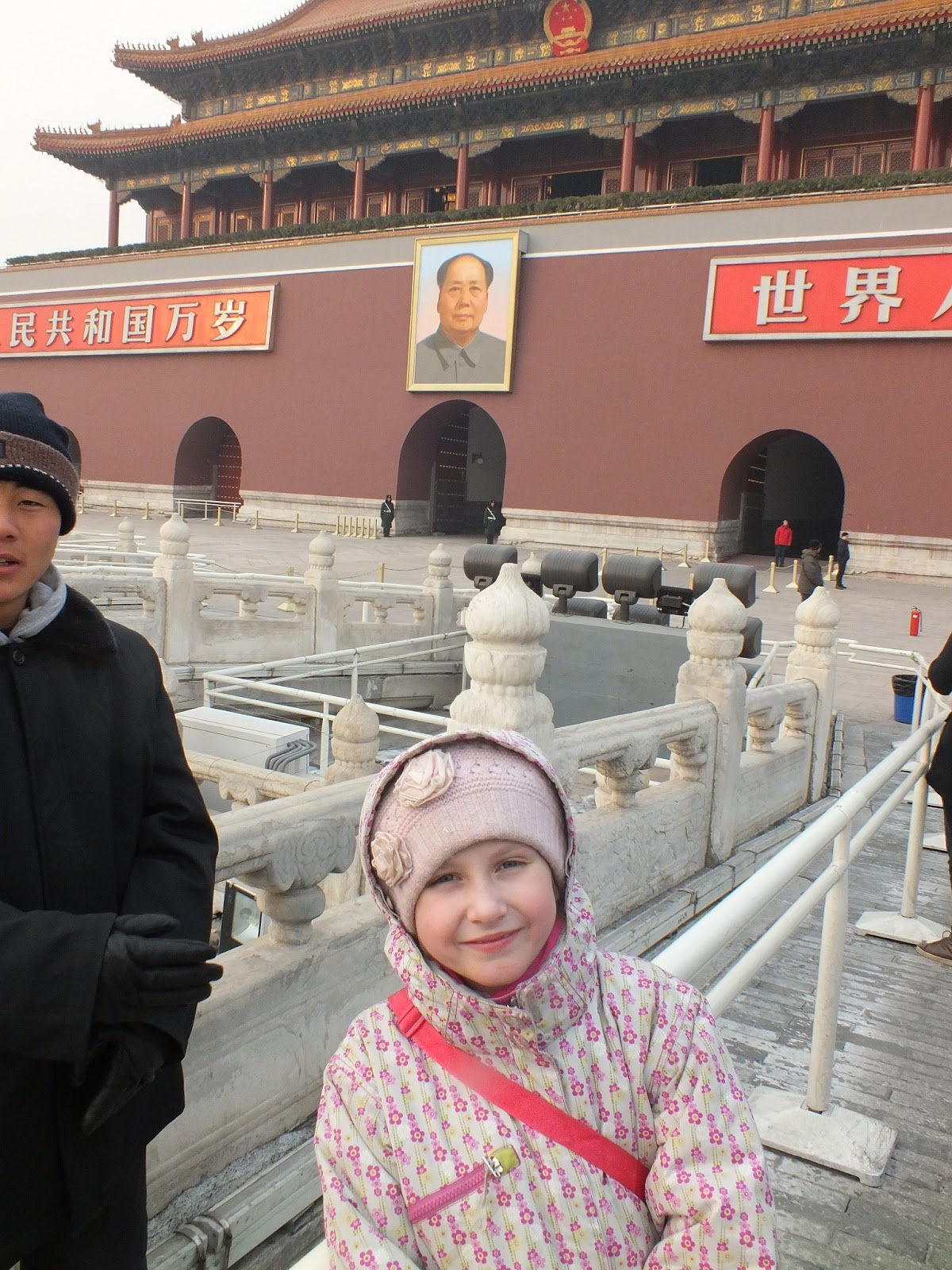
The actual Forbidden City is at one end of Tiananmen Square, separated by a busy main road. Its design is a series of several pagoda-style gate houses finally leading you to the throne of the Emperor. The first gate house now features a huge photo of Chairman Mao, founder of the People's Republic. Visitors pass through this first gate through a tunnel and into the first huge courtyard. On our first visit, due to earlier winter closing times, this is as far as we got. However the following day we managed to get into the main attraction and walked through several courtyards and gate-houses, taking in the ornate painted woodwork. The official map shows the vastness of the complex, littered with neatly places pagodas, each a sight in their own right. Only the cold distracted from the awe-inspiring reality of being metres away from the seat of the most powerful man on earth for much of recorded history. Time was not on our side and we had trains to catch, so we had to make our way through the complex at increasing pace. You emerge the other end of the Forbidden City somewhat in the middle of nowhere, although having been told the number of the trolleybus we made it back to where we needed to be. 

The evening of the first day of our visit, Lawrence and I decided to go and explore the city by night. It was a chance for a little adventure and also for some time to chat. Coming out of the hotel around 10-ish we realised it might be difficult to get transport and the taxi drivers wanted ridiculous sums of money to take us where we wanted to go. In the end we gambled on an electric rickshaw... Quite an experience. He took us along all the backstreets, the traditional hutongs, in the pitch dark. At one point we had a large car very close to our tail. At another he randomly stopped to change batteries. What had looked like fibreglass sides were actually cloth, keeping in the heat, but rather flimsy in the event of a collision (no, we were fine). We finally arrived at our destination, Qianmen street. By the time we got there the pedestrian precinct with a tram line running down the middle and major global brands like Haagen Daas and others, was deserted and closed. However turning off the main street we entered another world - a labyrinth of narrow alleyways packed with establishments selling food. We walked and walked, looking for somewhere still open and finally found a cafe-like place with a statue of Mao and friendly-looking staff. They can't have seen many foreigners because they insisted on taking our picture and asked Lawrence lots of questions about where we were from. The bill for the meal was also a fraction of what we had paid elsewhere and we had plenty eat and lots left over. We made our way back not knowing whether we found find transport, but there were plenty of taxis on the main road and it only cost us half of the rickshaw fare to get back (that's what comes of using the official meter instead of making up the price).


The next day we got up early for our trip to the Great Wall. I can't imagine there is anyone who has not heard of this great feat of engineering. It isn't disappointing and after an hour or so of driving due north from the city one starts to head uphill until the Wall is visible on the ridge of the mountains. The whole thing took something like 2000 years to build and its total length is over 8800 kms (only half is currently restored). That is something like the entire length of Russia from one end to another... of wall! The Wall, or the bit we visited, is accessible by cable car. The actual Wall, built of yellowy-grey stone, is rather like an extended rampart around a castle - only stretched out in one direction. Every 50 metres or so the wall is interrupted by a sort of turret, which is where soldiers would have been stationed. The edifice snakes off into the distance in either direction and one has a sense both of its magnitude and of the historical significance of this front-line of Chinese civilisation. When it came down to it the Mongols still got through and occupied the throne for a whole dynasty - although they say that it was the conquered who ultimately changed the conqueror and not vice versa. It was one of those sights which it actually doesn't take that long to visit. I guess we could have walked along for some distance, but Sophia's feet were frozen and it was slippy, so having seen it and taken the photos we made our way back.

We said goodbye to Conrad and Jenny in Beijing and headed off for our train back. I will save the account of our second Beijing visit for another post.