четверг, 24 января 2013 г.

Христианство в Индии

В нашем современном мире в начале XXI века "центр тяжести" перемещается от запада к востоку. Евросоюз и США переживают экономический упадок, если не кризис, а поднимаются два "гиганта" на востоке: Китай и Индия (обе страны - древние цивилизации, ядерные державы и имеют население более миллиарда).
Крест Св. Фомы

Хотя как человек западный и евро-центричный меня это в чем-то пугает, как космополит, историк и христианин понимаю, что это - нормально и в порядке вещей. 

Побыв в Китае я заинтересовался и вторым "гигантом" востока: Индия. 

Христианство проник в Индию с самых ранних времен. Есть достоверное предание, что именно Апостол Фома проповедовал здесь с 52г, обратил в веру представителей высшей касты браминов, основал церкви и рукополагал местных служителей. В 180г возможно приезжал в Индию христианский учитель, Пантен, и нашел общину, которая имела Евангелие от Матфея на "иврите" (возможно на арамейском языке). Индийских верующих в Христа называли и называют "насрани" от слова "Назорей". 

Когда в 345 прибыл в Индию торговец-миссионер, Фома Канский, вместе с 400 верующими-беженцами (их преследовали на родине), уже была община христиан. Они относились к несторианской общине восточной Сирии. Со временем связи с несторианской Церковью Востока укреплялись. Патриарх-несторианин Тимофей I учредил митрополию Индии. Появилось второе течение в индийском христианстве: "южные" несториане от Фомы Канского в отличие от "северных" прослеживающих свои корни до Апостола Фомы.  

В XVI португальские мореплаватели и миссионеры прибыли в Индию с благовестием и нашли существующую, самобытную церковь. Со временем церковь Святого Фомы разделилась по разным направлениям. Миссионерская работа велась и ведется и среди других народов Индии. Протестантские миссионеры присоединились к делу благовестия с начала XVIII века: сначала пиестисты из Германии, потом и евангельские христиане из Англии. 

На сегодняшний день христиане составляют около 2,3 % общего населения Индии. 

среда, 23 января 2013 г.

Impressions of China (Part IX): our last day in China

We woke early on 2 January to catch our train to Beijing with less that 24 hours to go before our flight home. Oxana did a good job packing our bags and cases and I got all the money and various documents ready for travel. What I didn't remember to do was to charge the iPad and the mobile phones. Mistake! We only realised this once we were on the train.

I have already written about the bullet train which connects Jinan and Beijing in under 2 hours. Very efficient and comfortable. And not withstanding our rather bulky luggage (with five of us we have a baggage allowance of 100kg but only two of us can actually carry stuff) we made it by taxi to the station and to the waiting hall with some time to spare. We said goodbye to Lawrence and Miao Miao in order to go down to the platform - we had said goodbye to Leo the previous day; we was staying with his Chinese grandparents and his cousin and friend, Jiao Chang.

The train journey was quite calm. We only discovered the uncharged equipment gradually - and were lulled into a false sense of relief when we were able to charge the iPad and Mum's phone in the carriage. It was only after we arrived in Beijing that we discovered our phone was down - and we were planning to split up later in the day.

Arriving in Beijing, we found the taxi rank and headed off for the airport. We had down all the ground work on our previous visit and knew where to go and how much approximately it would cost (about 100 RMB = 10 GBP).

On arriving at the airport we knew to make our way to the 'Aule lounge' which actually turned out to be the 'Hourly lounge'! At this point we were hoping to be able to check in, leave our luggage and relax for the rest of the day. However the booking arrangements were rather strange. Overnight accommodation was only available after 6pm and all the day-time rooms were full. We had to hand our belongings in at 'left luggage' and plan to be back dead on 6pm in the hope of being able to get a space.

The airport is connected to the underground network by a rail-link. We purchased our tickets and headed into town with about 2-3 hours for our tourist visit. Oxana, not having been with us on the previous trip, wanted to see the Forbidden City, while we were keen to visit the zoo and the Pandas. We separated paths slightly nervy with the phone not charged (there was very little battery left). Mum, myself and the three girls took the underground towards the zoo.

Beijing Zoo was great. It was Baltic - and we were frozen by the end of it - but we did find the pandas and spent most of our time seeing them and taking photographs. There must have been about 5 of them in various glass cages and outside. One amusing moment happened when a Chinese student, standing with her back to one of the world's rarest species, asked to take Sophia's photo. White-skinned non-Chinese Europeans are a rare species to the Han Chinese - even in cosmopolitan Beijing!

Time was catching up on us and although we did attempt to find the dolphins and then the giraffes, they were located at the far end of the zoo and various things were closed or inaccessible. In the end we started to make our way back to the airport, but not before Oxana rang to say she was lost and her phone was already virtually out of power, ruling out calling Lawrence and Miao Miao for help (in the end she was helped by some sort of 'citizens' patrol' which reminded Oxana of the good old days in the Soviet Union). It was a rather anxious trip back on the underground and rail-link and we were grateful to see Oxana when we got back. In the event the Hourly Lounge did have availability and we were able finally to dump our bags and relax.

We decided it would be nice to go for a meal together and had a mind to print off our boarding passes. Our meals were fine - generous bowls of noodles in a soya soup, but Mum's non-noodle meal was rather meagre. We then attempted to get some deserts elsewhere - and Mum something more substantial, but to no avail, as there was either very little selection or ludicrous prices. And you couldn't print your boarding pass at the airport for love or money. Even the office which did offer to print off allegedly didn't have internet access. After much ado - and a phonecall to S7 airlines Chinese office - we abandoned the undertaking. In the end I got Lawrence in Jinan to check us in online (although we didn't have a print out to prove this).

At the end of the evening I went for a coffee and a chat with Mum before retiring to bed.

The next morning began at 3am. On awaking I remembered that we needed our housekeys. You can imagine the increasing panic as they were not in the obvious places (where I thought I had left them). I was desparately rifling through all the bags, but no joy. To make things worse my call to Lawrence to book onto the flight had finished off our mobile credit, so we couldn't text folk in Siberia to make arrangements (as far as we knew our spare keys were a three-hour train's ride away from home!). Feeling suitably despondent we realised that if the keys were indeed with us we hadn't lost them in the room and we made our way upstairs for our flight. Mum had kindly awoken and said goodbye to us all. Before we checked in we had an unfortunate attempt to get our bags wrapped in cling film, falling victim to some scammers who pretended to be official aiport staff. The airline and airport stuff were unable to grasp what we were trying to explain; in China 'a little' English means just that. There wasn't much we could do and the scam had only really cost us 5 UK pounds. We had a nice final photo taken in front of an interesting sculpture in the terminal before heading off to the gate. After some hurried duty free shopping we were the last on the flight, which turned out to be virtually empty (20 or so folk).

The flight was quite relaxed... and in the relative calm I found the keys (in the blind panic earlier I had not properly checked one of the pockets on the suitcase). We arrived in Novosibirsk having had a half-decent sleep and kindly met by Alex Richardson.


And so ends our trip to China. 

вторник, 22 января 2013 г.

Impressions of China (Part VIII): Historic sites and Buddhist temples

We woke up on New Year's Day 2013 in China. Mum and Lawrence had been looking after the girls, so we had a nice lie-in. This was to be our last full day in Jinan, before heading back home via Beijing on 2 January. Lawrence rang to make sure we weren't too late, as my sister-in-law, Miao Miao, was keen to show us one more tourist sight before we left.


Earlier on our visit Miao Miao's Dad had shown us around the historic centre of Jinan: Daming lake. This bascially consists of a large park area enclosed by remains of the old city wall with a lake in the middle surrounded by various old buildings, including Buddhist temples. As in Beijing the layout is very open with wide spaces. The old Chinese buildings are pagoda-style and made of brick with intricately carved and painted wooded roofs.

To the untrained Judeo-Christian eye Buddist temples centre around a statue to which worship is offered in the form of incense sticks, other gifts and by bowing down, often with hands held together in a prayer-like gesture. It is difficult to tell, as we didn't get to ask anyone questions, but it would seem that the religious devotion is driven more by specific personal needs than by a sense of worship per se. Chinese, while very contemporary and holding to a scientific worldview, are quite superstitious and attach a lot of importance to the number eight and the colour red. A local custom is to attach red ribbons to special trees as a token of luck.


On the final day of our trip Miao Miao took us to a Buddhist site on the mountainous edge of the city. The complex was rather like a large park. We climbed up the hill and then walked down the hill among various very large statues of Buddha and other related figures, including a female representing kindness. For most of the visitors, possibly including us, the spiritual/religious aspect was incidental and on the square in front of a HUGE and apparently well-fed Buddha (right) were various go-carts and similar rides for children. While there were cushions for genuflexion and a tray for incense sticks in front of the statue, the overall ambience around the statue was more of a day out than worship or religious devotion. It was standing in front of this Buddha that Miao Miao starting to ask me probing question about faith and whether all the religions were not indeed the same.


The central piece of Buddhist site was the cave of ten thousand Buddhas, which basically did exactly what it says on the tin. The cave has obviously been renovated as a tourist site and is a warm, well-lit tunnel decorated by ten thousand (or certainly a very large number) of Buddhist statues. This part of the complex was more conducive to devotion and culminated in a shrine chamber where people were clearly earnestly engaged in acts of worship.

After the park we returned home to a meal of home-made Chinese dumplings and other food. If it weren't for the intenstinal after-shocks of our 'steak' house meal a couple of days before, we would have had a larger appetite, but it was tasty all the same. We were able to spend some more time with Miao Miao's parents and her sister and family (the latter all speak English) and to present some gifts from home.

In the evening I spent some time with Mum and Lawrence, going for a foot massage and then for a few games of pool with Lawrence. All good. I got to bed quite late and we had an early start catching the train to Beijing the following morning.


понедельник, 21 января 2013 г.

Фильм: "Причастье" (Ингмар Бергман, 1963)

Сегодня утром, по рекомендации молодого человека в церкви, я просмотрел фильм шведского директора Ингмара Бергмана: "Причастье" (1963г).

Фильм по атмосфере и по тематике суровый. 

Действие проходит в воскресный день зимой в провинциальной Швеции, где Томас Эрикссон несет служение пастором в государственной лютеранской церкви. Он уже не молодой и, как выясняется позже, он уже четыре года вдовец. На его первой службе присутствуют и принимают причастье пять человек: прислужник-инвалид, молодая супружеская пара, бабушка и молодая Марта.

После службы пара к нему подходит, чтобы беседовать. Муж страждет от депрессии в связи с переживанием о возможной ядерной войне с Китаем. Пастор Томас, сам пребывающий в глубокой депрессии и терзаемый сомнениями, не может утешать молодого мужа, а вместо этого делится своими сомнениями. В итоге молодой муж совершает самоубийство, оставляя без кормильца беременную жену и троих детей.

Еще в приходе присутствует Марта, любовница пастора, незамужняя, простая школьная учительница, замученная их сложными отношениями, но искренне любящая его. Она написала ему письмо, в котором она обвиняет пастора Томаса, но и объясняется ему в любви. После беседы с мужчиной, в итоге совершившим самоубийство, пастор наконец отрекается от веры в Бога, считая, что без Бога мир проще объяснить. Неоднократно он ссылается на "Божье молчание", что отражается в суровом молчании в самом фильме. Марта, сама атеистка, обнимает его. Пастор принимает ее ласки, но не отвечает на них. Потом входит бабушка, которая также присутствовала на службе, и передает новость о гибели молодого мужа, беседовавшего с пастором.

Пастор едет на место самоубийства, потом заезжает к Марте в школу. Оттуда он едет к жене покойника, чтобы передать новость о его смерти, беря с собой Марту.

В конце фильма Томас приезжает на еще одну службу в другой деревне. Перед службой с ним беседует прислужник-инвалид, который говорит об одиночестве и "сомнениях" Христа как о более страшных  страданиях для Христа, чем физические. Когда начинается служба в церкви присутствуют только пианист, прислужник и Марта.

Фильм впечатляющий, хоть и вовсе нехристианский, и пытаюсь вникать в его смысл вообще и для себя лично.

1) Во-первых фильм говорит об уходящем месте веры в пост-христианском мире. Ингмар Бергман выражает кризис веры в Швеции и вообще в Европе, показывая пустую церковь, сомневающегося пастора и людей лишенных надежды.

2) Во-вторых, если копать глубже, то мы видим корень этого "разочарования": напряжение между утешительной верой и неутешительной реальностью. Пастор Томас говорил о своей вере в доброго, Бога-Отца и о несовместимости этой утешительной веры с реалиями жизни. Находясь в Лиссабоне пастор игнорировал жестокости испанской гражданской войны, потом он потерял свою любимую жену, а теперь он мучается (и мучает) в сложных отношениях с любовницей. Его "разуверование" представляется не как освобождение, а скорее как отчаянный шаг ничем не улучшающий его участь. Высказанные сомнения пастора - последняя капля для мужа, который совершает самоубийство.

3) Каков выход? Молодой муж совершил самоубийство. Пьяный пианист в церкви предлагает Марте уехать, чтобы убежать от безисходности деревенской жизни. Марта сама теплит надежду о браке с Томасом. А пастор Томас просто хочет, чтобы его оставили в покое, в одиночестве. Он говорит, что он о себе уже не думает, что он умер вместе с женой. По большому счету не предлагается выход, разве только в размышлениях прислужника-инвалида или же в молитвенной просьбе Марты к Богу, чтобы он дал ей веру. Я воспринимаю эту просьбу, обращенную к Богу к концу фильма, как ее недовольство неверием и потребность верить. 

воскресенье, 20 января 2013 г.

Impressions of China (Part VII)

We arrived back from Beijing late on Friday evening; snow delayed the train by about an hour as we left late and travelled slightly slower. We only had a few days left in Jinan, as we were due to fly back to Russia very early on Thursday morning and Wednesday would be spent travelling to Beijing.

This symbol means horse and is pronounced 'ma'
As I have already said I made a concerted effort during my stay to make something of the Chinese characters and by the time we left China I could recognise and pronounce maybe 30 or so. It is estimated that about 2-3 thousand are required for functional literacy, but some are more commonly used than others and with my very limited knowledge every second or third sign made some sense.

My very limited knowledge of Chinese did not help me much when I went for a haircut. In future I will plan these things better and pre-empt particular situations. Basically, I just walked into the local hairdresser with mum and signalled that I would like a haircut. This prompted a mild panic and the obvious question, "Do you speak Chinese?" Having given the less preferable answer and when my brother Lawrence was unable to help over the mobile, I was invited to sit down and was given what I shall call a shampoo massage by an attractive female hairdresser. Somewhat embarassed and also aware of the potential cost I signalled that I wanted my hair cut (scissors gesture) and was whisked away to have my hair rinsed. The rest of the haircut was done by a male hairdresser. He asked the obvious question, namely, "What do you want done?" I hadn't planned this far ahead. A succession of outlandish Chinese hairstyles were flashed in front of me until we came across the nearest thing to front, back and sides (I exaggerate) - which I opted for. In the end it was rather short, but looked fine. There was also an 'ET' moment when one of the hairdressers pulled out Google Earth on his IPad and asked me where I was from. The simple explanation was to say 'Edinburgh'. Introducing Novosibirsk into the equation would have made things too complicated. There is only so much you can explain without words.

The next day Kiera and I went out exploring the town on the bus. We travelled into town and then walked around, finding a less up-market shopping street cum market and then finding ourselves near a shopping centre we had visited earlier. From here we jumped on a trolleybus, guessing that the overhead cables were more likely to take us straight ahead; our aim was to find the Chinese church we had attended on Christmas eve (photo right taken at night). We had not managed to make the morning service, and I was hopeful that maybe we could meet someone later on Sunday. We did find the church (I told Kiera to shout out when she saw a big cross), but it was all locked up and despite us hanging about for a wee while, no one came out and we went on our way. Once Kiera had exacted a present from me (princess set including battery-operated wand) we caught a taxi back to Lawrence's.

That evening we went out with Lawrence and Mum to another shopping centre, paying for the children to be in the play area and then went for a meal at the 'steak' house. The inverted commas around the word steak are largely due to the food poisoning Oxana got from her dodgy bit of beef.

The next day we travelled to the Zoo. It was rather cold again, although the day did turn out quite nice and we saw lots of animals and the children enjoyed it. Lawrence donned by Russian ushanka winter hat and did a very good impression of me. By this time it was rush hour and we spent ages getting back home in a very full bus, Kiera falling asleep on a step.


It was New Year's eve, which, much like 25 December, is not such a big deal in China. We decided to order KFC which combined with various snacks and fruit accumulated over the last few days was our Hogmanay meal (= 31 December). Oxana and I went off to see in the New Year together which Lawrence and Mum looked after Sophia, Kiera and Tanya. We didn't do anything wild - just saw in the New Year watching Chinese TV, trying to catch familiar words and characters on the screen. All very show-bizzy: boy bands and choreographed dancing troops performing to rousing tunes - patriotic but not political. Pictures of New Year then came in from various locations around China, including Taipei (capital of Taiwan, which is not officially recognised by the People's Republic of China).  

суббота, 19 января 2013 г.

Impressions of China (Part VI): Beijing

Having visited other world cities - London, Paris, Berlin, Milan, Rome, Moscow and now more recently Istanbul and Toronto - we were very keen to see Beijing. We almost didn't make it due to problems buying tickets and concerns about the children, but in the end we were able to make two short trips. We didn't regret it.

Sophia and I travelled to Beijing by bullet train. The Japanese-style trains - with airport-style train stations to match - were absolutely fantastic. We were travelling at 300 kmph for two hours in comfort for 20 pounds return. Very convenient and a classic example of the New China.

Beijing is not the ancient capital of China and, if memory serves, it has only been the capital city since the times of the Mongol ascendency in the 13th century, which incidentally coincided with the visit of Marco Polo. However that takes nothing from its stature and magnificence in today's China and today's world. 

The population of the city, whose name means 'Northern Stone', is around the 20 million mark. The smog problems publicised at the time of the 2008 Olympics and in the last few weeks were not a problem when we were there, however one is aware of being in a huge metropolis. Old and new peacefully co-exist, with vast housing complexes and commercial tower blocks intermingled with ancient pagoda's and the traditional hutongs (low-rise housing connected by narrow alley-ways). Beijing, particularly the centre, doesn't feel claustrophobic or excessively built-up. In fact there are lots of open spaces and a lot of the buildings are not particularly tall. 

Tiananmen Square
Our hotel, courtesy of Conrad and Jenny, was the Peace Novotel near the Forbidden City. The rooms were very comfortable and warm (we had become accustomed to being cold inside). It took us maybe 40 minutes by taxi to reach it from Beijing south station. Having left our belongings we made our way off towards the central sights. We stopped on the way to have lunch, which rather surprisingly was not unduly expensive and we were able to enjoy the privacy of a separate room. The usual fare of rice and accompanying dishes - all very tasty. We then made our way by foot to the forbidden city along a minor road lined with one-storey buildings with plenty of souvenirs for sale. It took longer than expected as the 1.3 km distance from the hotel did not take account of the entrance to the Forbidden City being at the other end.

As you walk onto the main thoroughfare you can feel the approaching immensity of Tiananmen square

For those who have been to Moscow, the parallel is Red Square - a huge expanse in front of the royal citadel (which is basically what the Forbidden city is/was), however multiply by at least two and add in the weight of history, the size of China and the events of 1989. The police presence is heavy and visible. Chinese are stopped and their ID card numbers registered in handheld computers. Bags are searched and to get onto the actual square, scanned airport-style. The entire space is covered with cameras which follow people as they move around. No one is taking any chances. 

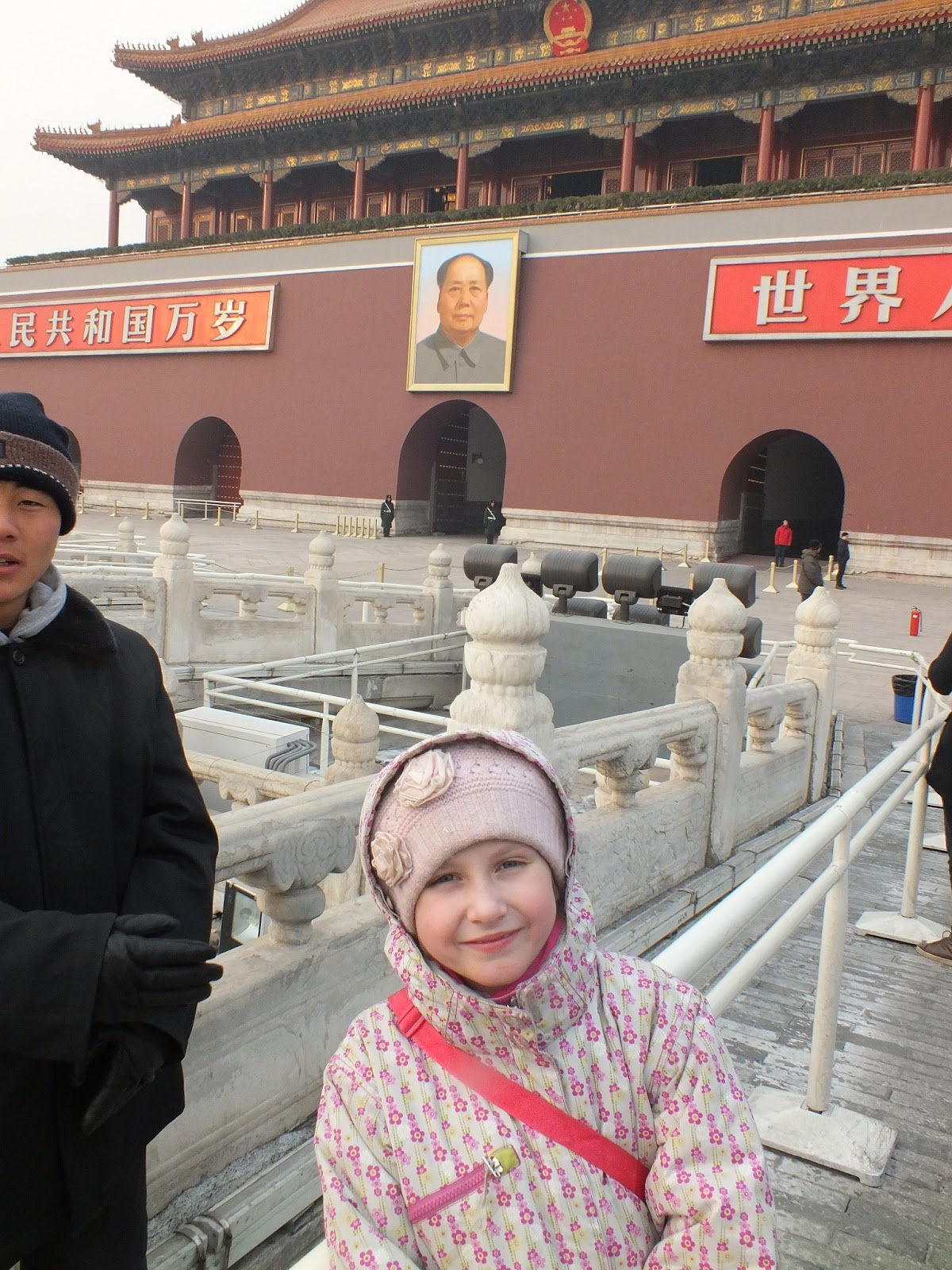
The actual Forbidden City is at one end of Tiananmen Square, separated by a busy main road. Its design is a series of several pagoda-style gate houses finally leading you to the throne of the Emperor. The first gate house now features a huge photo of Chairman Mao, founder of the People's Republic. Visitors pass through this first gate through a tunnel and into the first huge courtyard. On our first visit, due to earlier winter closing times, this is as far as we got. However the following day we managed to get into the main attraction and walked through several courtyards and gate-houses, taking in the ornate painted woodwork. The official map shows the vastness of the complex, littered with neatly places pagodas, each a sight in their own right. Only the cold distracted from the awe-inspiring reality of being metres away from the seat of the most powerful man on earth for much of recorded history. Time was not on our side and we had trains to catch, so we had to make our way through the complex at increasing pace. You emerge the other end of the Forbidden City somewhat in the middle of nowhere, although having been told the number of the trolleybus we made it back to where we needed to be. 

The evening of the first day of our visit, Lawrence and I decided to go and explore the city by night. It was a chance for a little adventure and also for some time to chat. Coming out of the hotel around 10-ish we realised it might be difficult to get transport and the taxi drivers wanted ridiculous sums of money to take us where we wanted to go. In the end we gambled on an electric rickshaw... Quite an experience. He took us along all the backstreets, the traditional hutongs, in the pitch dark. At one point we had a large car very close to our tail. At another he randomly stopped to change batteries. What had looked like fibreglass sides were actually cloth, keeping in the heat, but rather flimsy in the event of a collision (no, we were fine). We finally arrived at our destination, Qianmen street. By the time we got there the pedestrian precinct with a tram line running down the middle and major global brands like Haagen Daas and others, was deserted and closed. However turning off the main street we entered another world - a labyrinth of narrow alleyways packed with establishments selling food. We walked and walked, looking for somewhere still open and finally found a cafe-like place with a statue of Mao and friendly-looking staff. They can't have seen many foreigners because they insisted on taking our picture and asked Lawrence lots of questions about where we were from. The bill for the meal was also a fraction of what we had paid elsewhere and we had plenty eat and lots left over. We made our way back not knowing whether we found find transport, but there were plenty of taxis on the main road and it only cost us half of the rickshaw fare to get back (that's what comes of using the official meter instead of making up the price).


The next day we got up early for our trip to the Great Wall. I can't imagine there is anyone who has not heard of this great feat of engineering. It isn't disappointing and after an hour or so of driving due north from the city one starts to head uphill until the Wall is visible on the ridge of the mountains. The whole thing took something like 2000 years to build and its total length is over 8800 kms (only half is currently restored). That is something like the entire length of Russia from one end to another... of wall! The Wall, or the bit we visited, is accessible by cable car. The actual Wall, built of yellowy-grey stone, is rather like an extended rampart around a castle - only stretched out in one direction. Every 50 metres or so the wall is interrupted by a sort of turret, which is where soldiers would have been stationed. The edifice snakes off into the distance in either direction and one has a sense both of its magnitude and of the historical significance of this front-line of Chinese civilisation. When it came down to it the Mongols still got through and occupied the throne for a whole dynasty - although they say that it was the conquered who ultimately changed the conqueror and not vice versa. It was one of those sights which it actually doesn't take that long to visit. I guess we could have walked along for some distance, but Sophia's feet were frozen and it was slippy, so having seen it and taken the photos we made our way back.

We said goodbye to Conrad and Jenny in Beijing and headed off for our train back. I will save the account of our second Beijing visit for another post.


Impressions of China (Part V): Christmas and Boxing Day in China

When I was little, Christmas day was always the Special Day in the year par excellence. Commerce and parents hyped it up to fever pitch and I could never get to sleep on Christmas Eve, not least in expectation of a late-night visit from Father Christmas. Living in Russia, where the Orthodox Church still follows the Old Calendar, I have got used to the idea that not everyone celebrates Christmas day when I do. Not suprisingly in China Christmas day is a day like any other. So any festive cheer was always going to be self-generated. (Incidentally, New Year is much the same; the main holiday for the Chinese is in late January/early February.) Having purchased gifts for one another by Christmas Eve, we spent the latter part of the evening decorating the flat where we were staying. And in the morning everyone arrived early to open presents. Having done so we eventually made our way to a Mister Pizza restaurant for Christmas dinner. This was followed by some more shopping, as we had semi-chosen but not yet purchased the 'transformer' for little Leonardo (my cousin). Later in the evening we had a game of charades in the house, before everyone made their way home to relax. Everyone was quite tired after all the rushing about over recent days. It was a nice, quiet Christmas together, the last since we gathered in Edinburgh for New Year 2004 and, prior to that, since Christmas 2000.

Boxing Day, 26 December, was our last day all together in Jinan. The day began with Lawrence's and my family enjoying a tasty Chinese-style brunch out and a visit to the Post Office to send off our Christmas cards (complete with the names of the countries written in Chinese - an achievement!). I found the way to my nephew Leo's heart by drawing pictures which he had to guess the name of (photo). Later we had to purchase train tickets for our trip to Beijing the following day, which proved time-consuming and almost fell through altogether. In the end we purchased tickets for my middle brother, Conrad, and sister-in-law, Jenny, while we would chance our luck on the following day. Meanwhile, Lawrence planned activities tailored to Conrad: a visit to an amusement arcade and a Jackie Chan film.

The last film I watched with Jackie Chan was called 'Meals on wheels' and was almost cartoon-like in its characters and plot. However, CZ12, its English title was an improvement in some respects. It was of course goofy, however this time it was more 'James Bond meets Mr. Bean'. Jackie Chan is a big star in China, and our Beijing taxi driver referred to him as 'our Huang Di' (i.e. our Emperor)! The film was in multiple languages (Chinese, English, French and others) with Chinese subtitles. It was eminently followable for us; we were even able to pick out some of the Chinese (one, two, three and other simple phrases). The plot hinged around cultural artefacts stolen during the Second Opium War and the burning down of the Winter Palace in Beijing and during the course of the time 'stolen back' by a Scooby Doo gang of young Chinese. There was a definite patriotic feel to the film and spent time in China we could empathise with it. It was also just good fun and a family experience. Settings ranged from the banks of the Seine in Paris to a jungle island, from French chateaux to yachts at sea. The climax of the film involved skydiving over a volcano, from which Jackie Chan recovered to be reconciled with an out-of-sorts girlfriend.

In the evening we went out for a more up-market hot-pot meal (see part II). Mum found the experience a bit unpleasant, fearing food poisoning, however the more immediate danger was hypothermia, as the restaurant was poorly heated and even the cook seemed to be wearing a winter hat to keep warm. We finished off the day with a trip to KTV, which is basically karaoke, a hit with the locals and a chance to walk down memory lane and relax together before our trip to Beijing the next day.